



Christmas Thoughts on the MET’s Tiny Crib of the Infant Jesus
Michael E. DeSanctis, Editor
Buried somewhere in the collection of newspaper and magazine clippings I acquired during my decades of teaching both theology and art history at a Catholic university is a photo from 2001 of the federal execution chamber in Terre Haute, Indiana, where convicted Oklahoma City bomber Timothy McVeigh was put to death. I saved the picture not out of some morbid fascination with the place of McVeigh’s execution but for the view it offered of its floor, a mostly white-tiled surface offset by geometric arrangements of blue and grey squares clearly designed to please the eye.
Why such decorative touches should show up in the otherwise no-nonsense setting of a death chamber is anyone’s guess.
Having spent a career examining humanity’s powerful spiritual-aesthetic impulse, however, I’d say the floor nicely illustrates the lengths we humans will go to satisfy our itch for pattern-making. As members of a species sometimes called homo religiosus, we’re prone to connecting the existential dots that suggest our lives bear the mark of something celestial. As homo decorans, we’re forever arranging into patterns of our own invention the artful dots or sounds or word-forms, as the case might be, that render this mystery intelligible to the senses.
“The ethereal longs to become concrete,” I used to tell the budding theologians and art historians who once filled my classroom, a phenomenon that for Christians, at least, plays out most explicitly each December through the spectacular Word-become-fleshiness of the Christmastide.
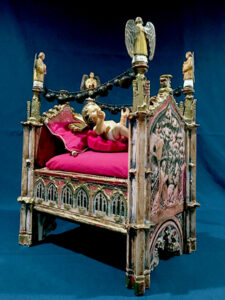 My special appreciation for the season’s incarnational thrust comes partly by way of designing large-scale Nativity displays, an avocation that led me recently to fabricate a replica of the so-called Crib of the Infant Jesus in the collection of the Metropolitan Museum of Art. New Yorkers and others with regular access to the MET will know this 15th-century artwork as the miniature cradle preserved in a display case all its own at the heart of Gallery 306, amid much larger remnants of late-medieval Christianity.
Originally in the possession of cloistered women who reverenced its accompanying Christ Child doll (now lost) as they might the divine newborn himself, the tiny, gilded crib shares little with the feeding trough that serves as Jesus’ first resting place in the Lucan account of his birth (Luke 2:7).
Despite its diminutive size, the MET crib poses a big challenge to modern viewers. We’re reluctant to trade the prevailing rationalism of our age for the mindset of the object’s original caretakers, even if it’s only a brush with “art” we seek from it today and nothing resembling prayer. The doll-sized crib seems too much a plaything to prompt lengthy introspection, the product of magic-tinged imaginations best left to children, artists or households of pious nuns.
We complain, nevertheless, of a workaday existence that seems anything but “celestial.” Ours is a world bereft of magic—which accounts for the nostalgia the crib elicits. While piecing together my modest facsimile of the MET crib, in fact, I personally longed not so much for the supposed innocence of childhood or to reside in some long-lost “Age of Faith” as for a taste of maturity free of the cynicism and self-absorption that afflict our generation.
Crib and cross are inseparable in Christian iconography, just as the joy of Christmas Day and despair of Good Friday are in some deeply unnerving way.
Like Christmas itself, which suffers if treated as an annual gimmick for “reviving the child” in people, the Crib of the Infant Jesus carries a thoroughly adult message that goes straight to humankind’s greatest source of anxiety. In the fashion of the scriptural manger for which it doubles, the crib represents not only a sacred breadbox for the one whom Christians regard the miraculous “Bread of Life” and “Manna from heaven” (John 6:48-56) but a small sarcophagus. The crib is both a tabernacle and a kind of tomb, birth and burial vessel in one. The “darling Jesus” whom visitors to the MET can imagine lying blissfully atop its mattress is likewise the dangling one central to every nearby Crucifixion scene the museum has to offer. Crib and cross are inseparable in Christian iconography, just as the joy of Christmas Day and despair of Good Friday are in some deeply unnerving way.
The MET crib no longer functions in the realm of sacrament, of course. Its reach is wider, its audience vastly more diversified than its maker could ever have anticipated. It retains, nevertheless, the same quality of piety hardened into expressive form we find in artifacts from so many other cultures throughout the museum’s vast collection.
If, especially at Christmastime, the crib persists in beguiling viewers of all stripes, it does so at the level of a whisper or the sound of a sleeping child. In its smallness it succeeds in squeezing through the gaps in our iron-clad exteriors, restores our bruised and weary psyches, and offers us an encounter with beauty that, in its own way, may well be redemptive.
Download a pdf version of this article here.
©2025 Emmanuel Magazine, Congregation of the Blessed Sacrament
All rights reserved.
Readers may reach editor Michael E. DeSanctis at editor@blessedsacrament.com and by mail at Emmanuel Magazine, Editorial Office, 220 Seminole Dr., Erie, PA, 16505.