


BOOK REVIEW
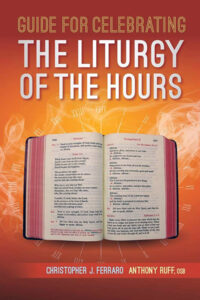 Guide for Celebrating The Liturgy of the Hours
By Christopher J. Ferraro and Father Anthomy Ruff, OSB
Chicago: Liturgy Training Publications, 2019
117 pages. Price available online.
Editor’s Note: Emmanuel Magazine is pleased again to offer, as it did routinely for years, reviews of books likely to be of interest to our readers. The review below was submitted by Very Rev. John Thomas Lane SSS, Superior of the Province of Saint Ann. MED
The brief hiatus of Emmanuel prevented me from reviewing this book when it originally made the scene in 2019. In the interest of full disclosure, I have written for the Liturgy Training Publication (LTP) over the years and provided one of the books in its series of guides for celebrating the rites of the Church. (I wrote the first and revised editions of its Guide for Celebrating Worship of the Eucharist Outside Mass, 2016). With the recently-announced publication of the Liturgy of the Hours, Second Edition, scheduled for implementation on Ash Wednesday 2027, it seems fitting to review and promote this publication, which, as its title suggests, “guides us” through the steps of the “second important” treasure of Catholic worship.
Unfortunately, the Liturgy of the Hours has not become as familiar to parishes throughout the world as the bishops of Vatican II had hoped. (See the Constitution on the Sacred Liturgy for an idea of what the council fathers had envisioned.) In the wake of the council, a revised and repurposed form of the Hours commonly came to be recited outside of Mass. Though intended to support the prayer of average Catholics, most today would likely not know that this liturgy is missing from their lives.
We all know the WWJD mantra: “What Would Jesus Do?” Well, Jesus prayed the Psalms, and if we really wanted to do what he did by living for God, all parishes would imitate his manner of prayer. The Liturgy of the Hours is our engagement with how we are to act as the worshiping People of God. After the Eucharist, this is the paramount liturgy of the Church. It prepares us for worship of the Eucharist and, in its own right, reveals how we might sanctify each hour of the day as an offering to God.
The work of a Benedictine monk (Ruff) and a well-known liturgical musician and writer (Ferraro), Guide for Celebrating The Liturgy of the Hours is a resource useful to everyone, but especially to parish ministers/leaders eager to introduce the beauty of the Hours to those they serve. Throughout the book, there are practical suggestions for keeping God’s time holy, sacred and special. Any volume devoted to so great a goal is important. This one encourages the lay members of parish communities to “get involved” in the liturgical life of the Church. By way of references to many of the Church’s legislative statements on liturgy, it should likewise inspire “pastors of souls” to do the same.
There are shortcomings to this volume, one being its limited presentation of the variety of ways in which the Liturgy of the Hours is celebrated, one religious order or congregation to another. It is also problematic that midway through their text the authors advise against ever combining the Hours with a celebration of the Mass. It should be said that during the COVID-10 epidemic, for example, religious orders and other communities benefitted greatly from doing just this. So sound from a pastoral perspective does the practice remain, in fact, that the book might have included a chart outlining how communities of different types might adopt it with due consistency. As it now stands in some diocesan seminaries, and in those parish settings where directors of worship follow instructions published by the Federation of Diocesan Liturgical Commissions (FDLC), unfortunately, lectors are instructed to refrain from saying “The Word of the Lord” after proclaiming the Scripture passages assigned them. We know, however, that the General Introduction to the Lectionary (1981) instructs the assembly to respond “Thanks be to God” after hearing the Word. Whenever God’s Word is proclaimed communally, we should be able to voice this acclamation and not hold it from our lips.
Among the book’s strengths are its suggestions for observing the Triduum (page 75), which are likely to be helpful to parishes intent on keeping holy the Hours of Holy Thursday and Good Friday. The same can be said of the attention the writers devote to the celebration with exposition of the Blessed Sacrament, the Office of the Dead and funerals. While the Guide highlights the history of the Didache and promotion of the Lord’s Prayer as part of the Hours, it does not describe the origins of its concluding acclamation: “For the kingdom, the power, and the glory are yours. . . .” The phrase is part of the Mass and appears in the Didache as the doxology to the Lord’s Prayer. Editions of the Hours published in Canada and by the Benedictine Community place this acclamation where the Didache has it. (See the Benedictine Liturgy of the Hours, where it appears in Latin and English.) One wonders, then, why it is omitted in many places in this country and not included in this resource? Liturgical law and history both allow the worship of particular communities—from parishes with strong ethnic identities to diocesan seminaries—to incorporate elements of local custom. These are not differentiated.
I hope others will discover Guide to Celebrating the Liturgy of the Hours and be moved to implement the Hours at the outset of Lent 2027. It is a great goal for the lay members of parishes, whether or not they enjoy the supervision of a religious order. It is also something to which pastors should aspire, as much in response to the contents of their vows as to any of the Church’s liturgical instructions. May all who read this book, regardless of the role they play within the Church, draw from it renewed purpose for seeing the Liturgy of the Hours welcomed into the prayer routines of their communities.
Download a pdf version of this article here.
©2026 Emmanuel Magazine, Congregation of the Blessed Sacrament
All rights reserved.
Readers may reach editor Michael E. DeSanctis at editor@blessedsacrament.com and by mail at Emmanuel Magazine, Editorial Office, 220 Seminole Dr., Erie, PA, 16505.