


Mauro Del Giudice
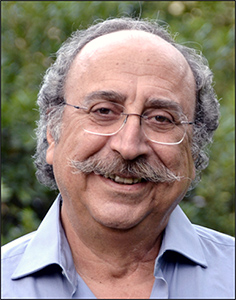 Editor’s Note: The following submission to Emmanuel Magazine comes from Mauro Del Giudice (b. 1953), who describes himself as a citizen of Rome, Italy, by “birth and vocation.” He holds an undergraduate degree in political science from the University of Rome, La Sapienza, and master’s degrees in related disciplines from the Social Studies Center, the foundation for Jesuit education in Rome. He has written widely on such topics as law, the environment and spirituality. His interest in education, the formation of young people and the proper catechesis of the Catholic faithful are attributable in part to his longstanding involvement as an educator and trainer in L’ Associazione Guide e Scouts Cattolici Italiani (Association of Italian Catholic Guides and Scouts, AGESCI), a Catholic scouting and guiding organization in Italy with nearly 200,000 members. For over a decade, he has been living the path of the Laity of the Eymardian Family, an association of lay men and women partnered with the Congregation of the Blessed Sacrament in promoting eucharistic spirituality and evangelization in one’s daily life.
The father of two, Del Giudice states that he draws inspiration from the power of music, the silence of the mountains and “the sacred value of friendship.” In this essay he challenges the Emmanuel readership to look upon each celebration of the Eucharist as more than an occasion for beholding the consecration of bread and wine. It is instead, he argues—as reinforced by the words of the Epiclesis prayer intoned by the priest (see below)—the means by which the assembly itself is sanctified and summonsed to live as the Body of Christ in the world. It’s for this reason that he sees the Epiclesis of the Mass as “the Church’s most openly political action” and an antidote to the extreme individualism that characterizes our age. MED
Introduction
This essay stems from a personal observation as simple as it is disturbing: in many of our Catholic churches today the transformative dimension of the Mass is demonstrated well enough at the altar but remains unfulfilled in the pews. By not fully internalizing both invocations of the Holy Spirit contained within the so-called “Epiclesis,” we are led to treat the Real Presence of Christ in the sacramental species with great reverence but fail to acknowledge the equally real presence he assumes in the body of the assembly. My aim in this essay is to identify some of the reasons why this might be so and to offer some advice to parish communities and others eager to gain greater appreciation for the truly “subversive,” world-changing nature of what we are up to when assembled for the mystery of the Eucharist.
The Two-Fold Nature of the Epiclesis
Perhaps not all Catholics are aware that there are two invocations of the Holy Spirit in that part of the Eucharistic Prayer we call the “Epiclesis”—one which the presider recites over the gifts of bread and wine destined to become the Body and Blood of Christ, a second over the assembly called to become “one body, one spirit in Christ.” The “physical miracle” that unfolds before our eyes is considered immediate and guaranteed, while the “social miracle” seems slow, fragile and unrealized. The difference in the way we perceive these two aspects of the same invocation might lie in the respective “materials” they involve. The bread and wine at the altar have no will of their own. They offer no resistance to the workings of the Spirit and are immediately transformed into something other than themselves. The corresponding transformation of the members of the assembly into something other—the eccesial Body of Christ—is not nearly as instantaneous. It requires an ongoing “yes” in the lives we lead beyond the boundaries of our places of worship.
Put another way, we can say that the consecration of bread and wine at Mass takes place at a precise moment in time. The consecration of the community, however, occurs gradually as we answer the priest’s invocation of the Spirit with our “Amen!” and thereby commit ourselves to being more patient, more charitable and more united as we go forth from our celebration. In effect, the part of the Epiclesis recited over the assembly changes the Mass from something we can treat as a singular, religious ritual into an ongoing conversion of its participants. I would argue, in fact, that the second part of the Epiclesis is the Church’s most openly political action. To call upon the Spirit to make us “one body” is to declare war on the individualism that so governs our modern world. If, after our “Amen,” we do not feel the burning of the wound of the poor, if we do not feel the discomfort in the face of injustice, we have celebrated only an imitation of unity. An assembly of impeccable practitioners or “users of the sacred” who do not take on the pain of others risks functioning merely as a social club. It invokes the Body of Christ as a pious concept but does not but does not welcome it to be enfleshed in the way its members treat each other and those in the wider world.
[W]e can say that the consecration of bread and wine at Mass takes place at a precise moment in time. The consecration of the community, however, occurs gradually as we answer the priest’s invocation of the Spirit with our “Amen!” and thereby commit ourselves to being more patient, charitable and united as we go forth from our celebration.
From Singular Rite to Gesture of Lifelong Conversion
In the Eucharist, God does not become bread and wine simply because God wishes to assume the appearance of these elements. God does so in order to transform all those blessed to consume them. Several factors contribute to the Catholic faithful not fully appreciating the implications of what we both do and become in our celebrations of the sacrament. One is the habit many of us exhibit of treating our reception of the Body and Blood of Christ from a Communion line as a kind of “spiritual selfie” that occurs in isolation from those around us. Another involves our attachment to the external or aesthetic details of our actions—what I sometimes call “liturgical cosmetics”—which might actually hide some degree of interior emptiness on our parts. When perfect singing, an abundance of incense or lavish vestments are treated as ends in themselves, they become distractions from authentic prayer rather than aids to it. It is easier to organize an impeccable choir, for example, than to help the opposing factions that sometimes coexist within our parishes to overcome their differences. An assembly that prays for unity but lives in division signals that it regards the words of the Epiclesis more as a magical formula than as an expression of existential commitment.
The same may be said of those of us desensitized to the implications of the Mass as they apply to the Church’s broader social responsibilities. If we are to become “one body,” the poverty of one must be understood as the wound of all. The members of a parish community who depart from Mass unscathed by the social injustices they encounter in society effectively thwart the actions of the Spirit they invoke. One cannot, as St. John Chrysostom noted centuries ago, “honor the Body of Christ” in worship while allowing it to be “an object of contempt in its members, that is, in the poor” on the streets of our cities (Homily 50 on the Gospel of Matthew, c. 390 CE). If the Spirit unites us with others in a substantive way, then the poor, the stranger or the enemy who sit beside us in a church (or stand just outside its doors) are to be treated as members of our own body. Overlooking the ethical dimension of the Epiclesis implies that we are willing to receive the sacramental Body of Christ in our rites while ignoring the suffering body of one’s brothers and sisters.
An assembly that prays for unity but lives in division signals that it regards the words of the Epiclesis more as a magical formula than as an expression of existential commitment.
Mutual Charity: Fruit of Our Celebration
To move from being “users of the sacred” to imitators of Jesus requires us to understand that we do not “take” God from the places in which we celebrate the Eucharist in the way one might withdraw money from an ATM. In our churches, it is God who does the taking. God grasps us and kneads us as a people into the “one bread, one body.” For St. Thomas Aquinas (1225-74), this was the res sacramenti—the “ultimate reality of the sacrament”—which in turn inspires our charity toward each other. The charity we exhibit as a liturgical community proves that the presiding priest’s invocation of the Spirit has not remained suspended in the air but is fully grounded in the other-directed behavior of those who comprise the “Mystical Body of Christ.” Saint Pope Pius XII said as much in his encyclical of 1943, Mystici Corporis. “[T]he unbroken tradition of the [Church] Fathers from the earliest times,” the pope insisted, “teaches that the Divine Redeemer and the Society which is His Body form but one mystical person, that is to say . . . the whole Christ” (67). Charity, the pope went on to say, is “God’s law” and therefore the virtue that binds us to Christ “more than any other” (73).
Conclusion: Embracing the Fullness of the Epiclesis
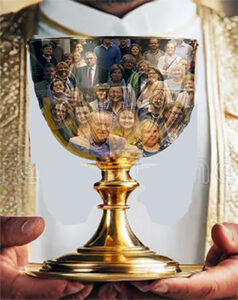 We have the antidote to the radical individualism that so afflicts our age. It is not an idea or a political program but the Epiclesis of the Mass, which is more than a set of words to be preserved within the pages of a Missal. Fully received and understood, the words of the Epiclesis remind us that liturgical prayer does not call us into private intimacy with Christ but to public cohesion as the very parts of his Body, the Church. In practical terms, this requires priests in their roles as presiders to make a noticeable pause after the invocation of the Holy Spirit, in a sense to “startle” the members of the assembly into greater awareness of their belonging to each other.
In his much-discussed May 2024 interview with 60 Minutes journalist Norah O’Donnell, our late Pope Francis (1936-2025) stressed that the Church is not a “customs house” so much as a common one. Similar images of the People of God have filled the public statements of Pope Leo XIV, whose instructions on prayer have encouraged us to seek relationship over ritual, discipleship over the comforts of religious services. Leo, whose priestly formation occurred within the Order of St. Augustine and who describes himself as a devoted “son of Augustine,” is well-aware of the saint’s famous instructions to communicants at Mass: “Receive what you are, to become what you receive.” That is, consume the Body and Blood of Christ (in sacramental form) so as to be reconstituted into Body of Christ (in communal form). Every liturgical gesture must remind us that the Mass does not so much “end” with the recessional hymn as give way to concrete acts of charity on the part of its participants. If the second invocation of the Epiclesis becomes a way of life for the average Catholic, the world may finally see what it has forgotten—that being brothers and sisters is not wishful thinking but the only reality capable of saving us.
Download a pdf version of this article here.
©2026 Emmanuel Magazine, Congregation of the Blessed Sacrament
All rights reserved.
Readers may reach editor Michael E. DeSanctis at editor@blessedsacrament.com and by mail at Emmanuel Magazine, Editorial Office, 220 Seminole Dr., Erie, PA, 16505.