



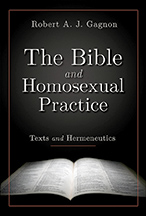
 The Bible and Homosexuality: Expanding our Image of God
Michael J. O’Loughlin, ed.
Paulist Press
Mahwah, NJ,
2025
This collection of sixteen brief articles not only considers scripture through a refreshing lens but calls for acceptance and empathy to those we often dub “the other.” The editor has drawn on well-known scholars, mostly men, as well as graduate students and even a civil rights lawyer. Some of the authors identify themselves as gay and approach the topic from their own experience.
The pieces discussing the actual scriptural texts note that translations of certain words often are dictated by their specific historical time and cultural mores. The result can be a misuse of Bible stories, what the book calls “clobber” passages. These can be used to condemn certain groups or actions.
Other more central messages in the same pericopes are ignored. One example is the Lot passage in Genesis 1: 9-11, where Lot’s generous hospitality or even the blatant exploitation of his virgin daughters are not the focus. Rather, the idea of gay sex between the townsmen and Lot’s guests becomes a club to use against gay persons even today. Did people of Lot’s time even know what “gay” was?
Some articles emphasize that the love of God embraces all without judgement. The first creation story points out God’s self-satisfaction with the excellence and exquisite variety of what God fashions, culminating with humanity. No footnote notes exceptions for variety in human gender.
In the second creation story, fertility is emphasized as being essential to human continuation—but one cannot take seriously this passage as either history or biology: God encouraging propagation with one’s clone? The bottom line of both Hebrew and Christian scripture is that God loves each of unconditionally, and dubiously translated “clobber quotes” should not be used to condemn any human person as unworthy of that love.
The book is easy to read without neglecting rigor. It draws on a meaty foundation of theology and scripture scholarship seasoned with compassion and personal testimony. It is rich, sensitive, and often personal. It is always difficult to review a book by various authors. This one, with its wide range of voices, does come together as a clear chorus of hope and expansive charity.
The articles are brief, scholarly, and poignant. They demonstrate a positive and loving picture of God’s love and inclusion of all, well beyond the “chosen” people of biblical times. It might be a wonderful Christmas gift for those who live in silos where people think and look alike and condemn not only LGBTQ people but persons of color or those from foreign lands. It might prompt homilists to look at scripture with a modern lens. To quote from one author’s summary, “We should cease talking about the problem of LGBTQ people and instead be thankful for their gifts. The dignity and beauty of difference is a legacy for all those who are members of the Body of Christ.”
Dolores Christi, Ph.D. Shaker Heights, Ohio
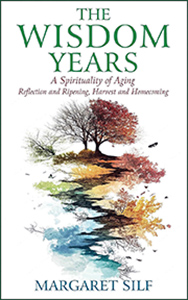 The Wisdom Years: A Spirituality of Aging Reflection and Ripening, Harvest and Homecoming
Margaret Silf
Paulist Press
Mahwah, NJ.
2025
The prologue of this book on the “wisdom years,” as they’re described here, encourages readers to re-focus their attention on the signposts along the path of older age that point to its spiritual value. Author Margaret Silf, a popular retreat director and speaker on Ignatian spirituality, walks the us through these signposts for navigating the aging process as an owner’s manual might.
Through stories and examples, Silf presents the tasks faced in aging: moving from active engagement to more quiet spaces of reflection and acceptance, letting go of assumptions and expectations that have been drivers, coming to appreciate and discover giftedness, accepting a diminishment of independence and the inevitability of death.
Along the way, Silf notes, the invitation of wisdom is ever-present. The aging individual can grow in wisdom and pass it on to others. Each chapter ends with a series of reflective questions designed to enable one to get in touch with the wisdom within.
The stories and examples collected in the book—and especially the reflection questions it offers—make it a versatile aid to those wishing to move from a passive mode of gaining to an active one. The book’s structure likewise makes it useful in small group settings, where participants can share their personal experiences of aging with each other. It also would be a valuable resource for those dealing with an aging person in a family or work situation open to walking with them with a sense of hope and meaning.
Treating this book as a companion on the journey through aging rather than as a once-and-done read opens readers to mining fully the wisdom it contains.
Mary Muehle Richmond Heights, Ohio
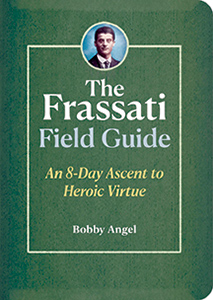 The Frassati Field Guide: An Eight Day Ascent to Heroic Virtue
Bobby Angel
Ave Maria Press
Notre Dame Indiana
2026
This book by educator Bobby Angel presents the story of Pier Giorgio Frassati (1901-1925), a third-order Dominican activist from Turn, Italy, canonized in 2025 and named patron of young people and students. I came upon it while assigned to the Church of St. Andrew in Lower Manhattan, New York City, where I was responsible for gathering biographical materials on the saints and those beatified by the Church likely to inspire our teenage candidates for Confirmation. Accessibly-written, and structured as one would the contents of an eight-day retreat, the book might well do some good tucked into the back packs of every high school and college student in the country—Catholic or otherwise.
The author presents the saint as a figure born into wealth but animated by great devotion to the Eucharist and to acts of charity flowing from it. At the age of only six, for example, Pier was apparently moved to give away his socks to a beggar boy he encountered. His desire to be charitable toward others persisted virtually to the moment of his death at twenty-four due to polio. A deathbed incident Angel recounts involved Frassati carefully giving caretakers the names and addresses of those to whom he wished his earthly possessions distributed.
The book reveals that Frassati was also a devoted mountain climber whose motto was Verso l’alto! —“To the heights!” “Every day that passes I fall more desperately in love with the mountain[s],” he is quoted as once saying: “I am more determined to climb the mountain[s], to scale [their] mighty peaks, to feel that pure joy that can only be felt in [them].” Readers may draw from such words a fitting metaphor for the spiritual ascent Pier underwent during his admittedly brief life.
This proved to be true for at least one of the confirmands I earlier mentioned, an avid skier and mountain climber himself, who ended up taking “Pier Giorgio” as his sacramental name—and with it, presumably, some measure of the saint’s desire to reach the highest heights of the soul.
Brother Michael Perez, SSS, Richfield, Ohio
Download a pdf version of this article here.
©2026 Emmanuel Magazine, Congregation of the Blessed Sacrament
All rights reserved.
Readers may reach editor Michael E. DeSanctis at editor@blessedsacrament.com and by mail at Emmanuel Magazine, Editorial Office, 220 Seminole Dr., Erie, PA, 16505.