



Modern. Reverent. Catholic.
Michael E. DeSanctis
 By Emmanuel Magazine standards, the following essay is probably a little on the long side and more pointed than usual. It’s one I felt a need to pen myself, however, in response to the increasing number of Catholic commentators online, most relatively young in age, who’ve taken to badmouthing nearly everything that’s been done in the name of liturgical reform and renewal in the Church since the time of the Second Vatican Council (1962-65). Most have no personal recollection of what the rites of the Church were like prior to council, nor do they seem particularly familiar with the day-to-day efforts of pastors and others today diligently working in their communities to offer them the most prayerful of liturgical experiences. The grumbling might be dismissed as part of the white noise that has come to fill such wide swathes of the internet, were it not for the confusion it sews among those faithful with no head for liturgical politics or participating in the so-called “culture wars” that dog the Church who nevertheless are doing their best simply to pray as our bishops instruct them.
“Talk is cheap,” the saying goes. The Greek philosophers long ago argued that it can also be “ugly” should it produce thinking in its listeners only half-way between ignorance and wisdom. Unfortunately, much of the negative chatter coming from Catholic websites these days is of the “half-way” variety—what Jesus might have judged lukewarm in its relationship to the truth. Big on enumerating the supposed heresies of the Vatican II bishops that led them to tamper with the shape of the Mass, primarily, as it stood since the time of the Council of Trent (1545-63), they paint a picture of ritual prayer at the local level at odds with that upheld, say, by the readers of this publication, whose devotion to the Christ in the Eucharist is unassailable.
It’s for this reason that I‘m happy to introduce a new feature to Emmanuel I’m calling “Modern, Reverent and Catholic: Worshiping With the Church in the Spirit of Our Time,” which will offer our subscribers from around the world a platform for publicizing the good work being done in their communities in the name of sacred worship. I invite anyone interested in contributing to this venture to contact me directly (editor@blessedsacrament.com) with written descriptions, photographs or other forms of documentation demonstrating what the rituals you regularly experience look and feel like. You may well wish to note the roles that music, architecture, the decorative arts and vesture play in their presentation. Such a clearinghouse of information puts to use the wider reach Emmanuel Magazine has gained since being revived in digital form about a year ago and is sure to inspire those liturgy planners, musicians, artisans, architects and others yet filled with the “zeal and patience” for ecclesiastical renewal asked of them by the fathers of Vatican II (Sacrosanctum Concilium, 19).
I look forward to hearing from many of you and making known widely the good things happening in your respective corners of the Church. MED
As senior editor of a publication for those with a deep attachment to the Liturgy of the Eucharist as it has come to be celebrated in the decades since the Second Vatican Council, I tire of the online commentary I come across daily by self-described “Traditional Catholics” from the U.S. and elsewhere critical of nearly every means the Church now employs to express its beliefs. By temperament as much as training, they seem a universally gloomy lot, prone to confusing solemnity with sullenness and thus to treating every celebration of the Mass as a kind of funerary rite for the crucified Christ on whom all Christians ultimately pin their salvation. Incapable of negotiating more than a single layer of theological meaning at a time, apparently, they balk at the idea that what’s unfolding at the altars of our churches is just as truly a wedding banquet from which Christ himself bids his bride, the Church, to draw the most extraordinary of foods, as it is an “unbloody reenactment of Calvary.” To hear them tell it, there’s little call for joy in celebrating the Eucharist, certainly nothing suggesting exuberance on the part of its lay participants, whose presence counts for little compared to the strictly heaven-directed actions of the presiding clergy.
To a person, these commentators exude a smugness comparable to that which Scripture attaches to the defenders of religious order in Jesus’ day. They convulse, for example, over the existence of the so-called “Novus Ordo”—the Order of Mass promulgated in 1969 by Saint Pope Paul VI in the wake of the council’s reform of the liturgy. (At least one spokesman for the camp, in fact, a staunch advocate for the universal restoration of the Mass in Latin, applies the phrase adjectivally, as when he describes any innovation proposed by more progressive voices in the Church as “so Novus Ordo” of them.) They characterize as sacrilege the habit adopted by the vast majority of Catholics in this country of receiving Communion in the hand, find issue with laywomen assuming any liturgical role placing them too close to the altar, and reject out-of-hand any music, art or architecture reflective of the principles of mainstream Modernism. (I’m speaking here of the movement in artistic expression that dates the mid-19th century, not the theological one famously condemned by Pope Saint Pius X.) Instead, their tastes run mostly toward warmed-over versions of what might be called the “Tridentine Baroque,” its highly filigreed evocations of the 17th-century court and chapel “timeless” in their eyes.
It’s hard not to liken such persons to the “prophets of doom . . . always forecasting disaster [within the Church],” of whom jolly, old Pope Saint John XXIII spoke in his famous opening address to the bishops of Vatican II (October 1962), self-appointed guardians of the Church given to condemning the world that has produced the very technologies of mass-communication on which they so greatly rely. The truth, of course, is that they don’t much care for the world in which they find themselves, a key to understanding the element of escapism that characterizes their behavior. A revival of medieval Christendom is what they long for, self-contained, theocratic and ruled over by a prelature draped in vintage finery. New Evangelization of the kind ushered into the Church forty years ago by Pope Saint John Paul II is of little interest to them. They’re drawn instead to old-fashioned apologetics, which, when done in the mic’d-up manner of today’s “shock jocks” or “digital influencers,” almost always assumes a loud and combative tone.
With only a little digging, one discovers that many are converts to Catholicism or returning to the religion after living for a time in ways contrary to its moral laws. It doesn’t take a psychologist, then, to identify the source of their zealotry. Regret has many ways of shaping the piety of lapsed or late-arriving Catholics, not the least of which is by appealing to their desire to conceal prior misdeeds or inadequacies beneath the clouds of incense, Palestrina-styled polyphony or brocaded vesture that lend any version of the Mass an air of otherworldliness.
In the Commonwealth of Pennsylvania, from where I write, we’ve long lived with a population of Old Order Anabaptists in our midst, better-known as the Amish, whose disdain for modernity similarly leads their members to reverence by way of strict imitation various centuries-old habits of their predecessors. Visitors to the Lancaster County area, where most nowadays remain concentrated, find them as curious as they are quaint for the living anachronism they embody. Like the dinosaurs and other ancient creatures featured in the popular Jurassic Park franchise of movies created by Steven Spielberg, or the slew of faux-antique churches in the late-19th century that continued to be constructed in our cities amidst skyscrapers framed in steel, they’re anomalies, artifacts of a time gone-by reappropriated to the present—but only through some selective sleight-of-hand. Forbidden by their interpretation of the Bible to use telephones within their homes, for example, Amish families don’t shrink from erecting communal outbuildings known as “phone shanties” in which they may chat away with others undisclosed. A similar blurring of the lines between strict antiquarianism and modern-day practicality shows up in the horse-drawn buggies for which they’re famous, outfitted as they’ve become with state-of-the-art operating lights and hydraulic brake systems on their outsides and cabin comfort accessories within.
The tourists in skinny jeans and Air Jordans who roam the local souvenir malls are in on the deal and know that half the merchandise sold there is shipped in from China. They’re only looking for items with a vaguely Amish “look” to them, after all, inexpensive knockoffs of the real things to lend their homes a touch of rustic charm. Few actually wish to live as the Amish do, the toughest part of which might well be parting with their iPhones. They know intuitively, as the prevailing model of life in the U.S. makes abundantly clear, that within every culture lies an interior dynamic, evolutionary in nature, affecting everything from the way its members think to the way they speak and dress.
Ecclesiastical culture is no exception. Were the Roman Catholic Church not open to changes from within of its own, written histories of it might be confined to a single page—most of it filled with the formative exploits of the apostles. They might be encapsulated in one of those descriptive statements found alongside objects in an art museum, or a specimen label from a display case in a natural science laboratory. Instead, even the briefest accounts of the life of the Church, including its way with worship, require several chapters to capture. What this suggests is that, like any species of living organism, the members of Christ’s ecclesial body change from time to time in response to variations in the socio-cultural environments in which they thrive. Their fundamental beliefs may indeed remain fixed, but the fossil record of their outward expression offers sure proof of their evolution.
 The bugaboo for Catholic commentators hoping to preserve a “deposit of faith” they imagine as having been handed down whole from the first generations of Christians to our very own, like the beards and bonnets of the Amish, is that change of the kind I’ve described might throw into question the legitimacy of almost everything on which the Church pronounces. A popular, Texas-based podcaster in his forties who spent years as an Episcopal priest, for example, comes off as peeved that a kind of ecclesiastical bait-and-switch was done to him at the time of his conversion to Catholicism. He’d hoped to join a Christian body whose habits were immutable but now finds himself surrounded, in his words, by “Novus Ordo types” unfazed by the notion that a church as old as ours might need a good airing out from time to time. Another, whose background in law enforcement and amateur boxing translates into an on-air style big on rule-keeping, machismo and a “battle-ready” approach to spirituality, equates being a “true [American] Catholic” today with allegiance solely to the MAGA Movement and makes no provision for Spirit-directed progress within the Church such as that described in a Vatican II instruction like Verbum Dei (2.8). A third, who’s actually an American Catholic bishop, regularly voices the opinion that postconciliar changes in the style and setting of the Mass prevent its lay participants from focusing their attention “upward,” as they once did, toward God’s presumed dwelling place beyond the clouds. From his perspective, the faithful have grown too focused on themselves and the most mundane of their concerns—a sentiment as hard to square with the most recent findings of Catholic astrophysicists about the nature of cosmos as with the metaphysics of the Middle Ages on which the Church has historically relied to explain how a Christ transcending space and time enters into both at each celebration of the Eucharist.
Where such digital commentators consistently falter is in providing solid evidence of any kind to support their claims that worship in our parishes today is qualitatively inferior to what it had been seven or eight decades ago. To do so, of course, would require them to engage an army of observers to peer into the prayer lives of the country’s nearly 18,000 Catholic parishes. Should it involve assessment of the artistic dimension of the liturgy found there, it would likewise demand greater examination of specific examples of sacred art than they are accustomed to providing, apart from which their judgments are rendered meaningless. My hunch is that most have little facility with dissecting the formal aspects of a particular hymn setting, building or two-dimensional image, nor with fitting such things into their proper cultural-historical context. Neither task is easy, nor does it produce the instant notoriety that comes from spouting offhanded comments into a microphone certain to titillate an audience already convinced the Church is doomed.
What results is a Catholic internet culture awash in a level of dilettantism that wouldn’t be tolerated elsewhere—certainly not in academic circles nor in those privileged those corners of WASP or Jewish-American society where the arts are discussed with considerable discernment. These keepers of the Church’s electronic voice boxes come off as mere dabblers, amateurs, opinionizers whose backgrounds reflect little personal familiarity with the art-making process itself, the complexity of its history or the commonly-accepted methodologies applied to its assessment. Even if they should be able to quote the Catechism of the Catholic Church from cover to cover, the personal likes and dislikes related to artistic expression they share with their followers are primarily de gustibus.
The latter is never more apparent than when they publicly critique artworks of any genre shaped by the aesthetics of the Modernist Movement dominant throughout Europe and the United States from the mid-19th century until roughly 1975, when it it was supplanted by the various strains of Postmodernism we live with today. In the works of such pioneering Modernists as Picasso, Stravinsky or LeCorbusier, each of whom thoroughly mastered the “rules” of their respective artforms as preserved within Europe’s royal academies and seats of ecclesiastical authority before surpassing their limitations, they see only ruin. They respond in the same way to the novel modes of thinking and acting subsequently adopted by whole generations of artists in the West, while never denouncing the achievements of Thomas Edison, Alexander Graham Bell or Henry Ford and their successors, whose practical innovations were born of the same impulse. It’s to the inventors of the Modern/Postmodern World—no small number of whom remained steadfastly devoted to the Christian mission—that the Church owes many of the marvels it now takes for granted. The latter imagined a world enriched by a plurality of ideas, to art defined less by form than by function, and to a comingling of the sacred and the profane. “Radically incarnational” might be a useful way of labeling the worldview at their core. Their sense of God’s involvement in the life of the Church doesn’t necessitate two, separate categories of thought—one perfectly de novo and attuned to the immediate needs of society, another reserved for spiritual affairs and therefore necessarily retrograde. In the Gospel accounts of how Jesus lived his life they find reason enough to seek a merger of the human and the divine, the temporal and the eternal, the old and the new. Imagining Christian worship as having “vertical” and “horizontal” dimensions separate from each other eludes them, Jesus, our Emmanuel in human flesh, fundamentally abolished the need for such distinctions.
What clearly escapes the mic-wielding critics of ecclesiastical art in the Modernist mode is realization that no act of human creativity, no matter how seemingly “revolutionary,” is so novel as to be entirely detached from its antecedents. The very tradition they’re fond of spelling with a capital “T” is itself the product of innumerable modifications on the part of its contributors. In boasting of Catholic culture having given rise, say, to church buildings on the model of ancient Roman law courts, to figurative art all kinds once thought unfitting for in a house of God, or to musical melodies performed on instruments, they unintentionally concede to the fact that it does not remain static but changes with as the needs and aspirations of the faithful likewise change. The pointed arches and other elements of Gothic origin inserted into the preexisting fabric of such Romanesque-styled places of medieval worship as the famous Abbey Church at Cluny or Paris’ Church of Saint-Denis, for example, offer clear evidence of how the new in Catholic art can be seamlessly grafted to the old with praiseworthy implications. Another, from a bit earlier, might be the way in which the improvised reconfigurations of the cantus firmus melodies once sung in monastic settings spurred development of the polyphonic compositions of Guillaume de Machaut, Josquin des Prez, and Orlande de Lassus, which the Church now counts among its treasures of musical composition. What serious lover of Catholic painting, in fact, would object to the advances in pictorial representation of the Italian Renaissance (c. 1300-1550), that have allowed both great and mediocre painters ever since to depict Jesus himself as a believable occupant of a world ruled by gravity, light and shadow—not as a cardboard cut-out laminated on gold in the manner of medieval iconography?
To those who claim that nothing of comparable significance has surfaced in the Church as a consequence of Vatican II, one could reference the handsomely-appointed provisions for the sacraments of Baptism and Penance parishes have introduced in their churches, positive departures, from their architectural treatment prior to the council. In the realm of sacred music, one might cite the compositions of French priest and scholar Lucien Deiss CSSp, (1921–2007), Boston-based C. Alexander Peloquin (1918-1997) or Chicagoan Richard Proulx (1937-2010), among others, whose Mass settings, psalm melodies and anthems are of indisputable quality. The same might be said of those professional design and decorating firms who commonly advertising in such preservation-minded publications as the National Catholic Register, Sacred Arts Journal or the glossy trade magazine, Traditional Building, for example, whose pages are filled with just as many projects involving mewer places of worship as older ones.
One could argue that we Catholics should be more open to experiencing novel expressions of the sacred than other religious groups. At every celebration of the Mass, after all, we watch as bread and wine are transformed into wholly new substances through means that are as instantaneous as they are mysterious. In celebrating our other sacraments, too, we hold that in a blink of an eye the “old person” present in each of us gives way to one born anew in Christ. Any Catholic blessed to be a parent or grandparent knows that the history of a family can be viewed from two perspectives, one backward-looking and respectful of the achievements of one’s entire ancestry, another facing forward with gratitude toward what is likely to be achieved by one’s descendants. The story of a family of faith—even one as large as ours—is perceivable in the same way and elicits as much gratitude to God for the insights of its current and future members as for those who preceded them.
The problem as I see it, then, is not an intellectual one. Today’s mic-wielding critics of Catholic worship and art reflecting the features our time are certainly capable of understanding the principles that guide them. Their tendency to find only fault with the modern world, however, blinds then to much of the good that has emerged from it. This includes the more direct means of communication Western society in general has adopted over the last century-and-a-half, or so, which can be said to have had just as big an effect on the way people pray as the way in which they paint or sing or build. (This very essay, for example, conforms to commonly-accepted rules of grammar, syntax and punctuation that make it more legible to the modern reader than most of the prose styles of previous eras.)
Any Catholic blessed to be a parent or grandparent knows that the history of a family can be viewed from two perspectives, one backward-looking and respectful of the achievements of one’s entire ancestry, another facing forward with gratitude toward what is likely to be achieved by one’s descendants. The story of a family of faith—even one as large as ours—is perceivable in the same way….
Curiously enough, the comprehensive change in the way we in the West pray or paint hasn’t posed too great a challenge to Jews in this country. The Modern-styled synagogues and homes of the numerous Ashkenazi Jewish neighbors among whom I was raised in the Central New York city of my youth, for example, were filled with paintings, sculpture, furniture, music and literature embodying the spirit of the age–none viewed as threatening to a body of religious beliefs twice old as the one upheld by my family. The cemeteries in which they buried their dead were likewise filled with grave markers and mausolea that bore little connection to the artistic conventions of the past. The Jews who were close family friends or schoolmates of mine were themselves parts of families who’d fled the Old World in the years leading up to World War II, after all, and with it the long history of bigotry they’d endured there. To them, “the New Art” of the period was as much a blessing to their culture as any other aspect of the glorious New World that had welcomed them.
A similar mindset seemed to possess members of the city’s sizeable population of Italian-American immigrants, only one step removed from existence among the peasantry of Italy’s southernmost provinces and the indifference often shown them there by a pseudo-aristocratic clergy. Many remained poor as newcomers to the United States and second-class citizens within a church dominated by an Irish-American episcopate disdainful of their ways. When it came to burying their dead, erecting homes for themselves or even houses of worship they were not reluctant to do things in the most modern (and Modern-styled) of ways. Such was certainly the case with the members of my own extended family, as proud of the improved lifestyles they’d secured for themselves in a country where everything seemed new as they were a Latin surname drawn straight from the pages of the Roman Missal. Theirs was a practical approach to religion whose blending of old and new was as prominent as the broken English they spoke—several parts Neapolitan or Calabrian or Paglian dialect liberally mixed together with sounds borrowed from the native “-Merigans” with whom they rubbed shoulders.
Not surprisingly, then, my people leapt at the invitation extended them as a result of Vatican II to assume places before the altar-tables of their churches as prominent as those they cherished the tavoli da parnzo within their homes. They understood the unifying effects of dining in the company of others, a deep-seated habit of the Italian people, along with the sacrificial dimension every meal embodies. At the first available opportunity, my relatives took to serving as lectors, cantors and extraordinary ministers of Holy Communion in their parishes—roles they assumed with great seriousness of purpose. The changes occurring within their church were sources of excitement to them, eager as they were to help reshape its worship as a people with eye for beauty.
None of this is to suggest that Catholics in the U.S. belonging to other ethnic groups or countries of origin were any less enthusiastic during the era of conciliar deliberation about the direction in which the Church was headed. Prominent in my memory of the period was the pride with which the members of a pair of parishes in my hometown—one “Irish,” the other “German”—unveiled shiny, new churches looking nothing like those in which their ancestors had worshiped. Designed even before the revisions to the General Instruction of the Roman Missal (1969) had been formalized, both were semi-circular in plan and appointed with furnishings and art whose forms owed themselves to the abstracting tendencies of Cubism. The flight of American Catholics to the suburbs in the decades since has been accompanied by an explosion of church-building along similar lines, its theoretical origins traceable to the 1830s and those monastic centers of scholarship on the Mass throughout the world that would give rise to the international Liturgical Movement.
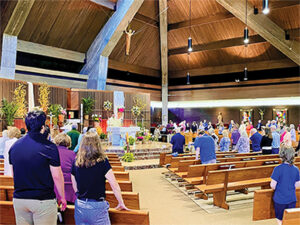
Worshiping in settings and in a style supportive of their “full, conscious and active participation” (Sacrosanctum Concilium, 14) is what the vast majority of laypeople in this country have come to expect from their church, studies reveal. Generally, they remain unswayed by criticism of the “Vatican II-ized flavor of Catholicism” of the kind they encounter today through social media and only infrequently demonstrate interest in seeing the Mass in Latin restored to universal use. Most of the adults seeking membership in the Church my wife and I routinely serve as facilitators of our parish’s OCIA (Order of Christian Initiation for Adults) initiative, for example, exhibit less interest in its antiquity than in the perennial youthfulness with which it helps believers addresses the spiritual challenges of their times. They’re hardly the “Kumbaya-singing Hippies,” “troublemaking Boomers” or “aging radicals” wed to the riotous decades of their youth their critics make them out to be. Instead, as one adult confirmand recently put it, they belong to a cohort of adults “who’d never think of joining the Church had it not first been revitalized by Vatican II.”
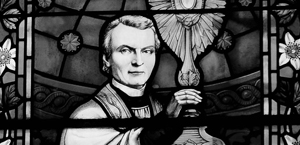
Today, more emphatically than ever, the Church wishes to serve all humanity as an instrument of its salvation. In so wishing, it must emulate the divine servanthood of Christ himself (Mark 10:45), whose revelation in eucharistic form was of key importance to St. Peter Julian Eymard (1811-68), founder of the very religious congregation responsible for publication of this magazine. In the Eucharist, Christ serves his followers without “pomp or majesty,” the saint once wrote, and calls upon each of his followers to practice this “royal virtue” (In the Light of the Monstrance, 1947). In proposing that the words, actions and gestures surrounding the eucharistic mystery “not only may but ought to be changed” when necessary (Sacrosanctum Concilium, 21, emphasis mine) the bishops of Vatican II displayed an Eymardian understanding of ecclesiastical humility. While never expressing doubt in the Church’s stewardship of Truth, the council fathers nevertheless admitted that any institution that fancies itself “magisterial” must be ever attentive to the practical needs of those presumes to teach.
Worshiping in settings and in a style supportive of their “full, conscious and active participation” (Sacrosanctum Concilium, 14) is what the vast majority of laypeople in this country have come to expect from their church, studies reveal.
One wonders whether a dose of the same humility might not make more productive the Catholics’ ongoing discussions concerning worship. Adopting some version of the “twin-perspective” view of family histories to which I referred earlier couldn’t hurt. The council so much as indicated the benefits of this view when it spoke of “resourcement,” an acknowledgement of ecclesiastical tradition going back to its sources, being the basis for any sound “aggiornamenti” (updates) it might propose.” Though a “strabismus” as it affects the vision of an individual might well represent a disability, the presence of eyesight capable of surveying the backward and forward of time in the same instant surely works as a blessing to a church as old as ours. It reveals at once full breadth and beauty of its time on this earth, , affirms the variety of ways in which it has expressed its beliefs, and again, in the manner of Eymard, collapses sacred history into an “Eternal Now” suffused with the presence of Christ (My Eucharistic Day, 1954).
Download a pdf version of this article here.
©2026 Emmanuel Magazine, Congregation of the Blessed Sacrament
All rights reserved.
Readers may reach editor Michael E. DeSanctis at editor@blessedsacrament.com and by mail at Emmanuel Magazine, Editorial Office, 220 Seminole Dr., Erie, PA, 16505.