


To Consecrate the Course of the Day: On Praying the Divine Office
Michael Centore
 Editor’s Note: Emmanuel Magazine is pleased to share with its readers the following submission by Michael Centore, editor of Tomorrow’s American Catholic (formerly Today’s American Catholic), an online publication that affirms the importance of sacred tradition while embracing, in the words of Pope Leo XIV, “new forms and new languages in which [the faithful might] proclaim the Gospel” (Address to Members of the Theological Faculty of Puglia and of the Theological Institute of Calabria, March 2026). Centore describes here his personal attachment to the Liturgy of the Hours—also known as the Divine Office—a form of prayer attuned to the “great global rhythm,” as he puts it, that aids the Universal Church in sanctifying the hours of each day. His reflection emphasizes the participatory nature of life in the Church by citing the liturgical instructions of the Second Vatican Council and key statements from the Vatican study groups currently directing its efforts toward synodality. Prayer is the key to the shared experience of unity and holiness, Centore concludes, whether it be of the “wordless,” silent kind or in verbal forms “passed down through our tradition, codified in our breviaries, and renewed, breath-like, with every repetition on an individual, collective, and generational scale.” MED
The 19th century German poet, Heinrich Heine (1797-1856), famously referred to the Hebrew Bible as the “portable homeland” of the Jewish people. While caution must be taken with this expression—it can be seen to consign the Jews to a state of permanent exile by substituting their holy scriptures for the covenant of their land—as a purely poetic image it retains a singular power, particularly for “People of the Book” whose faith practices are shaped and conditioned by an ever-evolving relationship to sacred texts. Heine’s phrase has always stayed with me, as its notion of “portability” and finding shelter and sustenance within a house of language resonates deeply with my own experience of daily spiritual reading—from the Bible, of course, in the form of lectio divina, but in other devotional texts as well: the lives and writings of the saints, patristic and matristic handbooks on prayer, the songlike cadences of religious poetry. One such text that I encounter daily is known officially as Benedictine Daily Prayer, a version of the breviary anchored in the liturgical life of the Benedictine monastic tradition.
The Experience of the Breviary
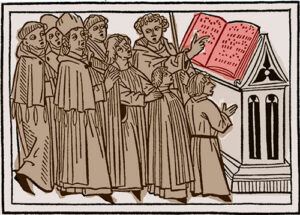
A breviary—alternately referred to as the Divine Office or Liturgy of the Hours—is a compendium of prayers, psalms, hymns, and Scripture passages designed to be read or recited at specific times of the day known as canonical hours. In the Benedictine breviary, there are seven canonical hours: Vigils (sometimes called Nocturns, Matins, or the Office of Readings), prescribed for midnight; Lauds, upon waking; Terce, at midmorning; Sext, at noon; None, at midafternoon; Vespers, at sundown; and Compline, just before retiring to bed. In a monastic setting, each of these hours would be tethered to a precise time of day—beginning with Lauds at 6 a.m., then recurring every three hours until Vespers at 6 p.m., likely punctuated by bells—but there may be a bit of flexibility for those praying outside the monastic enclosure. My own prayer practice privileges three of the canonical hours—Lauds, Vespers, and Compline—with attendance to the “Little Hours” of Terce, Sext, and None as the Holy Spirit inspires and as accords with the many duties and unforeseen occurrences of any person living in the world. If I find I can’t break away to properly pray the Little Hours, I take recourse to the Jesus Prayer, whose dart-like accuracy (“Lord Jesus Christ, Son of God, have mercy on me, a sinner”) and adherence to the cyclical nature of breath lends it a swiftness and transportability—it is already in the body, one doesn’t even need a book. The nocturnal office of Vigils has been helpful in bouts of insomnia, those 3 a.m. moments when every one of our past shames and failings seem to taunt us, and the only way to quiet them is to gather them together and give them over to God in the act of offertory prayer.
Like Heine’s “portable homeland”—again, bracketing this term for its poetic valence and the way it lights up the life-giving relationship between reader and text—the breviary has afforded me a kind of “portable monastery,” a house of contemplation framed in prayer that I can take with me into any situation. The pattern of this lay monastic life is laid out in the order of the readings, strengthened by the fact that hundreds if not thousands of others are praying this pattern concurrently. One feels a part of a great global rhythm of prayer, even as the experience of being “housed” in the breviary is an intensely personal one: my thumbprints, for instance, after years of referring to the rubrics in “The Ordinary of the Liturgy of the Hours” that make up the basic structure of the daily prayers have discolored the corners of the pages, and there are small tears from where I’ve moved the marking ribbons too quickly and caught against a bottom edge. These “scars,” such as they are, form a record of prayer as an embodied experience, much in the way we might prostrate on all fours (in reality, all sixes) and touch our foreheads to the floor as a way of sealing our supplication.
The breviary also brings with it a deeper sense of time. Open to the introduction and there is a chronological table, twelve columns across two pages, laying out the annual lectionary cycles (Years A, B, or C) and start dates of each of the four weekly rotations of psalms that alternate throughout the year. In my edition of the breviary, the current year—2026—is the end flank of the first of these two-page spreads that begins with 2015; the next spread ends with 2038, and the one following that with 2050. Even a quick perusal of these pages conjures the movement of a lifetime of prayer, perhaps even a prayer for a lifetime of prayer as one follows the descension of dates. The elements of “The Ordinary of the Liturgy of the Hours” that are repeated daily acquire here a binding power as they unify whole seasons of prayer. I am thinking in particular of the Lucan canticles—the Benedictus (Luke 1:68-79), the Magnificat (Luke 1:46-66), and the Nunc Dimittis (Luke 2:29-32)—that are recited at Lauds, Vespers, and Compline, respectively. Each day in Ordinary Time concludes with an intonation of the Salve Regina, the 11th-century hymn to Mary whose graceful melody seems to attune one’s mind perfectly to the intention of the Nunc Dimittis offered just moments before: “Now, Lord, let your servant go in peace; your word has been fulfilled.”
One feels a part of a great global rhythm of prayer, even as the experience of being “housed” in the breviary is an intensely personal one: my thumbprints, for instance, after years of referring to the rubrics in “The Ordinary of the Liturgy of the Hours” that make up the basic structure of the daily prayers have discolored the corners of the pages, and there are small tears from where I’ve moved the marking ribbons too quickly and caught against a bottom edge.
Praying in the Name of the Church
In the Constitution on the Sacred Liturgy (Sacrosanctum Concilium, 1963) of Vatican II, which identified active participation in divine worship by the unified People of God as the “pre-eminent manifestation of the Church” (41), we find an entire chapter devoted to the Divine Office. “By tradition going back to early Christian times,” the document notes, “the divine office is devised so that the whole course of the day and night is made holy by the praises of God” (84). Like any of the Church’s formal means of prayer, wrote the council fathers, the Office is never a private affair but part of a communal expression of praise to the Father rendered by the Church, that is, the Mystical Body of Christ in all its parts and members:
Christ Jesus, high priest of the new and eternal covenant, taking human nature, introduced into this earthly exile that hymn which is sung throughout all ages in the halls of heaven. He joins the entire community of mankind to Himself, associating it with His own singing of this canticle of divine praise.
For he continues His priestly work through the agency of His Church, which is ceaselessly engaged in praising the Lord and interceding for the salvation of the whole world. She does this, not only by celebrating the eucharist, but also in other ways, especially by praying the divine office (83).
In a similar way, the introduction to the breviary used by members of the Carthusian Order, who, like the Benedictines, have their own form of the Liturgy of the Hours, similarly emphasizes the corporate nature of the Divine Office. “The person who prays the psalms in the Liturgy of the Hours,” reads the introduction, “does so not so much in his own person as in the name of the Church, and, in fact, in the person of Christ himself.” A little later it makes clear that in the Office “the public cycle of the psalms is gone through, not as a private exercise but in the name of the Church, even by someone saying an Hour by himself (Carthusian Diurnal, 1985).
[T]he breviary has afforded me a kind of “portable monastery,” a house of contemplation framed in prayer that I can take with me into any situation.
A direct connection can be made between the participatory and priestly nature of the Divine Office as set forth in Sacrosanctum Concilium and the questions developed more recently, throughout the 2021–2024 Synod on Synodality. That Synod, oriented toward three thematic pillars of communion, participation, and mission, was convened by the late Pope Francis as a means of implementing the Second Vatican Council’s vision of the church as the People of God. “Although synodality is not explicitly found as a term or as a concept in the teaching of Vatican II, it is fair to say that synodality is at the heart of the work of renewal the Council was encouraging,” the International Theological Commission wrote in its 2018 prefatory document, Synodality in the Life and Mission of the Church (6). The document continues: “The fruits of the renewal promised by Vatican II in its promotion of ecclesial communion, episcopal collegiality and thinking and acting ‘synodally’ have been rich and precious. There is, however, still a long way to go in the direction mapped out by the Council” (8). One vector in this direction is the reimagining of liturgical theory and practice, a point made explicit in the Synod’s Final Document:
The liturgy is a listening to the Word of God and a response to His covenantal initiative. Similarly, the synodal assembly is a listening to this same Word, which resounds as much in the signs of the times as in the hearts of the faithful, and also a response of the assembly that is discerning God’s will in order to put it into practice. Deepening the link between liturgy and synodality will help all Christian communities, in the diversity of their cultures and traditions, to adopt celebratory styles that make visible the face of a synodal Church. (27)
To this end, the Final Document called for the formation of a Study Group “entrusted with reflection on how to make liturgical celebrations more an expression of synodality” (27). Pope Leo XIV authorized this group in July 2025, along with another focused on the statutes of episcopal conferences. These two new groups were added to the ten previously established by Pope Francis in 2024 to examine some of the more contentious issues that had arisen throughout the synodal process.
In November 2025, the Study Groups released their interim reports. These were not meant to be definitive but rather to give some sense of the research, progress, and methodology of each of the groups until they could produce their final reports, several of which have already been issued at the time of this writing. The interim report of the Study Group on “Liturgy in a Synodal Perspective” included framing questions to help direct its research and reflection. Many of these, taken on their own, could be fruitful lines of inquiry for “thinking with the church” about the evolution of liturgical practice; one in particular has for me a special bearing on the Divine Office: “How can paths of mystagogical liturgical formation be promoted for the People of God, the ministers, ordained, instituted and de facto, so as to ‘recover the capacity to live completely the liturgical action’ (Desiderio Desideravi, 27) and rediscover how the liturgy is the summit and source of synodality?”
Living the Liturgical Action
It is this admonition to “recover the capacity to live completely the liturgical action” that so captures my imagination. It is worth quoting here the entire paragraph of Desiderio Desideravi, the apostolic letter on the liturgy issued by Pope Francis in 2022, from which it is drawn:
Therefore, the fundamental question is this: how do we recover the capacity to live completely the liturgical action? This was the objective of the Council’s reform. The challenge is extremely demanding because modern people—not in all cultures to the same degree—have lost the capacity to engage with symbolic action, which is an essential trait of the liturgical act (27).
The Divine Office trains us to put on a liturgical mind, which is close cousin to the faculty of the sacramental imagination that sees God as active in all things. One might say the practice of praying the Divine Office structures the sacramental imagination by giving it an undergirding of regularity and rhythm from which more spontaneous expressions of praise can arise. It also reintroduces us to the life of symbol through the routine recitation of the psalms, where we begin to “live and experience them as if they were [our] own songs, [our] own prayers,” as Thomas Merton wrote in Bread in the Wilderness. When we immerse ourselves in the language of the psalms, their images connect us back to the ancient roots of Jewish and Christian prayer and come alive for us in our own time. This acts as a corrective to what Merton later diagnosed as the “trend of modern thought away from symbolism [that] has frustrated the basic human need for symbol and metaphor to the point of perversion,” a warning Pope Francis repeated nearly sixty years later in his apostolic letter:
[Theologian Romano] Guardini writes, “Here there is outlined the first task of the work of liturgical formation: man must become once again capable of symbols.” This is a responsibility for all, for ordained ministers and the faithful alike. The task is not easy because modern man has become illiterate, no longer able to read symbols; it is almost as if their existence is not even suspected. (44)
In praying the psalms as part of the Divine Office, we enter into that place where symbol and reality overlap—a frame of biblical time where, for instance, “fire and hail, snow and mist” (Ps 148:8), “grass on the roof that withers before it flowers” (Ps 129:6), or an “abundance of corn and new wine” (Ps 4:7) evoke more than they name. Incorporating them into our prayer, and therefore into our body and soul, they take on new shades of personal meaning that we sense through an almost physicalized metaphor. In other words, we feel the fire we intone as fire, a burning for the love of creation; the grass we intone as grass, parched to the roots and in need of the life-giving water God alone can provide; the corn and new wine we intone as corn and new wine, the satiety of joy and peace that are the fruits of our prayer. This last example has eucharistic overtones, which is appropriate given that the task of becoming “capable of symbols” we undertake in daily prayer is tested and proven through our participation in the Mass. Here we experience the reunification of symbol and reality that was intrinsic to patristic sacramental theology but has ruptured over time. The symbol that “embodies [reality] as its very expression and mode of manifestation” and serves as the “mode of presence and operation” of the divine mystery is brought to its fullest form of expression in Christ’s institution of the Eucharist, as the influential Orthodox priest and theologian, Rev. Alexander Schmemann (1921-83), once noted:
[T]he institution of sacraments by Christ (a theme which will obsess the later theology) is not the creation ex nihilo of the “sacramentality” itself, of the sacrament as means of cognition and participation. In the words of Christ, “do this in remembrance of me,” the this (meal, thanksgiving, breaking of bread) is already “sacramental.” The institution means that by being referred to Christ, “filled” with Christ, the symbol is fulfilled and becomes sacrament (For the Life of the World: Sacraments and Orthodoxy, 1963).
Elsewhere in Desiderio Desideravi, Francis quotes Guardini again in relation to the question of liturgical formation: “carried along by this inner transformation of our time, we must learn anew how to relate religiously as fully human beings” (34). To “relate religiously” suggests to me that the faithful must become their own liturgical agents—not in a way that supplants the priestly vocation, but that opens each one to the unique ways they manifest the universal priesthood of all believers. This is liturgy in the sense of the “consecration of the course of the day,” to borrow a phrase from the General Instruction on the Liturgy of the Hours (1971), a document from the Congregation for Divine Worship and the Discipline of the Sacraments. Every believer is called to participate in this consecrating action, this making-holy the time and materials of creation by offering them back to God. The primary avenue for this participation is prayer—the wordless, silent prayer of attentiveness to Presence as well as the verbal prayers passed down through our tradition, codified in our breviaries, and renewed, breath-like, with every repetition on an individual, collective, and generational scale.
Download a pdf version of this article here.
©2026 Emmanuel Magazine, Congregation of the Blessed Sacrament
All rights reserved.
Readers may reach editor Michael E. DeSanctis at editor@blessedsacrament.com and by mail at Emmanuel Magazine, Editorial Office, 220 Seminole Dr., Erie, PA, 16505.