




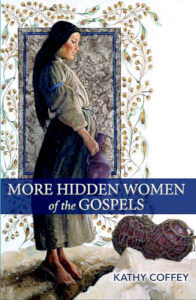
More Hidden Women of the Gospels
Kathy Coffey, Orbis Books, Maryknoll, New York, 2020.
My first reaction to the book was not favorable. A bit snobby on scripture, I was put off by the midrashic approach to selective passages. As I read further, my opinion changed.
The book creates first person back stories for women in scripture, many of whom often are left in the shadows, with little attention paid to them, maybe a reference, perhaps a name, a sentence: Herodias’ daughter, the caregiver of the deaf-mute in Mark, Prisca. For the most part, women seem unimportant in the scriptural text. In John’s gospel, for example, Mary (never named) is merely a symbol: a metaphor for church.
Coffey’s work attempts to move women into the light. She creates first person back stories for each. And breathes life into them. The stories often emphasize the pain and marginalization with which today’s readers likely identify. Each chapter ends with an analysis of the character from a contemporary context. The chapters are brief; the insights are deep.
Part One features women in the gospels. The author draws from scripture parallels but also incorporates comments from some of today’s popular writers (David Brooks, Nicholas Kristof, Richard Rohr, Barbara Reid—to mention a few) to enrich and support her observations. Each chapter provides questions that would be fruitful for a discussion group.
Part Two explores the fictitious women in Jesus’ parables. Coffey does a marvelous job of describing in their voices the strength, trials, and rich realities of these women. “Tell them their work is holy” orders an ancient baker woman. Even those who labor over dough create bread which will become the bread of life.
Part Three highlights four women named in the Acts of the Apostles. The last two sections of the book might be described as “homework.” More questions suitable for personal reflection are included. The final section deals with group resources and how the stories can be incorporated into liturgy. It concentrates on women who have more than a walk-on function, those whose biblical stories are more fleshed out in the original text.
About the only criticism I have is that many of the questions are sometimes long and convoluted. That might limit a group from exploring them more deeply. The author respects and incorporates the work of biblical scholars (check the many footnotes), pertinent biblical parallels, and a clear understanding of psychology.
Coffey’s insights into women, their work, their thoughts, their pain transcend the written pages of the Bible. Sometimes her words bring a reader close to tears, as the poignant ancient stories resonate with today’s reality. This book is not a trivial take on scripture. Like a good glass of wine, it must be sipped slowly and not too much at one time. It would be great for personal reflection and for group discussion.
Dolores L. Christie, Ph.D. Shaker Heights, Ohio
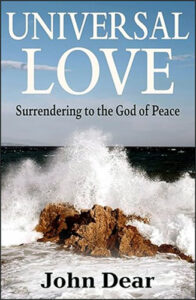 Universal Love: Surrendering to the God of Peace
John Dear. Maryknoll, NY: Orbis, 2025. ISBN: 978-1-62698-651-0.
In this three-part reflection, peace activist and priest, John Dear, draws us into his ongoing conversation with Will, his gym instructor who, during the Covid lock-down, asked Fr. Dear to become his spiritual director. Interestingly, at the start of their conversations, Will admitted that he did not believe in God. But when invited to say what he did believe in, Will responded, “I believe in truth and love and compassion.” After some discussion and reference to the New Testament’s assertion that “God is love,” they agreed to speak of “Universal Love, the God of Peace.” The remainder of the book guides us through Fr. Dear’s reflections on their explorations, focusing on what it means to surrender to Universal Love and to become a beacon of that Love in our fractured world.
Part One of the book introduces Will into meditation as a means of opening to and connecting with Universal Love as the path to peace. In breathing in and living this peace, Will discovers that he can become an extension of Universal Love. It does not come easily in our culture of violence, Fr. Dear points out, but over time with continued practice, surrendering to Universal Love, the God of Peace, becomes simpler and more conscious throughout the day.
In their conversations at the Blackhorse Café, Fr. Dear also speaks of his own struggles with self-will and letting go to receive the graces of humility and compassion. He speaks of how spiritual pride can block the flow of Universal Love. Throughout the book, he offers prayers he has found helpful in asking for the graces of greater peace and surrender.
Part Two focuses on “Living Within the Boundaries of Nonviolence.” Here, the depth of Dear’s lifelong dedication to peace activism comes to the fore. His suggestions to Will include practical ideas from Marshall Rosenberg’s Nonviolent Communications as well as reflections from Thich Nhat Hanh’s writings and Ghandi’s assertion that “Devotion to nonviolence is the highest expression of humanity’s conscious state.” Dear offers advice on how to practice peace even when someone irks or speaks hurtful words. He speaks of the necessity of forgiving everyone who has ever hurt us and living every moment in the practice of peace, despite our “neanderthal nature.”
Part Three explores, “Becoming a Channel of God’s Peace in a Peaceless World.” Will’s many conversations with Fr. Dear lead him to discover that surrendering to Universal Love means finding ways to serve others. Dear’s reflection in this section includes touching examples of conversations with his friends and collaborators who have dedicated their lives to healing and peace-making. These include Paul Farmer, founder of the international nonprofit Partners in Health, Daniel Berrigan and Philip Berrigan (with whom Dear shared a jail cell during one of their many arrests protesting U.S. involvement in wars and nuclear weapons armament). Dear’s call for peace-making in this section of the book also includes examples of caring for our immigrants and a clear call to end the death penalty. He ends this section with a description of his friend, former Hollywood film-maker Gerry Straub, who gave up his career to establish Santa Chiara, a home for orphaned, but now thriving children, amid the horrific suffering of Port-au-Prince, Haiti.
John Dear’s book is an engaging journey into what it means to surrender to the God of Peace in all its dimensions, both personal and societal. He presents a vision of hope, while realistically acknowledging the daunting task of peace-making. He also urges us to trust Universal Love, the God of Peace, to provide us with the strength and graces necessary to carry forward.
Barbara J. Fleischer, Ph.D. Associate Professor Emerita Loyola Institute for Ministry Loyola University
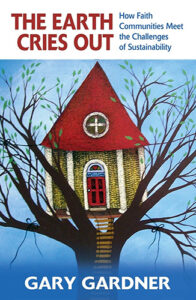
The Earth Cries Out: How Faith Communities Meet the Challenges of Sustainability
Gary Gardner, Maryknoll, N.Y.: Orbis, 2021.
The fact that this volume was published five years ago should not deter anyone from picking it up. It is an invaluable and very readable discussion of various dimensions of sustainability and an excellent resource for faith communities as they discern what “the cry of the Earth and the cry of the poor” is asking of them.
In Part I, consisting of the first two chapters, Gardner describes the sustainability problem in broad strokes and then moves on to prescribe an antidote. The sustainability crisis is humanity’s posture before the natural world. It is “one of control, of lording over, of playing the master, rather than one of mutuality, humility, and gratitude” (5). This dominance, Gardner explains, is global, unprecedented, involving every domain of life in an interconnected manner and is extremely dangerous to humanity and the earth. It is ultimately a corruption of the dominion given to humanity in Genesis.
The antidote to this crisis is “sustainable development” which Gardner defines as “the wholesale makeover of economies to favor human well-being within boundaries set by nature” (12). This will require a fundamental transformation of attitudes and behaviors across societies, an “ecological conversion” in the words of Pope Francis. Such a conversion entails “a dramatic makeover in thinking that reveals the natural world as sacred and humanity’s position in it as one of kinship” of mutuality, reverence and gratitude (16). Our Catholic tradition injects into the notion of sustainability “spiritual and moral components” that “emphasize human dignity and purpose,” referred to in many papal documents as “integral development.”
In Part II, titled “The Cry of the Earth,” Gardner explores how a different relationship with nature might affect our approach to and use of energy, food, water and land. Each of the four chapters, as Gardner explains, “features a faith-driven innovation that embraces nature in relationship to humanity and is infused with the spirit of God” (24). Throughout these chapters, Gardner provides numerous examples of how various types of faith communities employ sustainable practices toward these aspects of creation. The chapters are replete with examples and resources that are faith inspired.
Part III focuses on consumerism, or excessive consumption, which drives environmental destruction and how faith-informed approaches to sustainability can mitigate this problem. Gardner devotes Part IV and its four chapters—social enterprise, investment, fair trade and local finance—to hearing “the cry of the poor” and the role that people of faith can and do play in helping to hear and address that cry. Each of these Parts is introduced by a brief discussion of relevant sections of Laudato Si to bring church teaching to bear on the topic. And each Chapter in the three parts ends with a section called “Leavenings” that issues a clarion call to faith communities and what they might contribute to the conversion needed in relation to the issue addressed in that chapter.
In Part V, “Raising Voices,” Gardner, in the next to last chapter, underscores the need for prophetic voices to help avoid climate catastrophe and increase the prospects of building sustainable societies. He describes the fundamental characteristics of prophets, the great need for religious advocacy work, and various instruments for engaging in advocacy. In the final chapter, Gardner applies the “see, judge, act” methodology to the role of faith communities in the task of building sustainable societies.
The Earth Cries Out is a clearly written, engaging, challenging and extremely rich resource for people of faith to address one of the greatest crises of our time. As Gardner explains: “The book is not a road map for building sustainable faith institutions or sustainable economies. … Instead of a how-to manual on sustainability, the nine issues demonstrate the potential range and power of faith communities for jump-starting the creation of sustainable economies and societies” (xvii). All that is needed is for faith communities to hear the cry of the earth and the cry of the poor, muster the fortitude, and then take up the challenge. “Our faith traditions offer inspiring visions of a better, more dignified and humane world. Why not create a new order that reflects the values we hold dear? Why not embrace this moment of gift, recognizing it as a path to the kingdom?” (219). Why not? Why not take up the challenge and begin by asking what the cry of the Earth and the cry of the poor are asking of us given our faith commitments?
Ronald P. Hamel, Ph.D. Senior Ethicist Emeritus The Catholic Health Care Association St. Louis, Missouri
Download a pdf version of this article here.
©2026 Emmanuel Magazine, Congregation of the Blessed Sacrament
All rights reserved.
Readers may reach editor Michael E. DeSanctis at editor@blessedsacrament.com and by mail at Emmanuel Magazine, Editorial Office, 220 Seminole Dr., Erie, PA, 16505.