



Editor’s Note: We recently introduced a new feature to Emmanuel Magazine called “Modern, Reverent & Catholic: Worshiping With the Church in the Spirit of Our Time.” Its purpose is to offer readers from around the world a platform for sharing the efforts being made in their respective churches to promote sacred worship as it was envisioned seventy years ago by the fathers of Vatican II. So strongly does Pope Leo endorse the council’s instructions on liturgy and other matters pertinent to the life of the Church in our time that this spring, over the course of some fourteen Public Audience sessions, he reiterated them in detail as part of a “Catechesis on the Second Vatican Council” of his own design. Leo has stated that the council remains the “North Star” to which Catholics today should fix their gaze, a source of orientation and illumination that may guide us toward a model of church in which all members are recognized as active participants.
Mauro Del Giudice, a subscriber from Rome, Italy, whose essay, “The Epiclesis of the Mass: A Prayer in Two Parts,” appeared in the April 4, 2026, installment of Emmanuel, was the first to respond to our invitation to write a little about the way the style and settings of corporate prayer can affect one’s experience of intimacy with Christ. We thank Mauro for his submission and encourage others in our Emmanuel family to consider doing likewise. MED
In the Place of the Father, the Son and the Holy Spirit
Mauro Del Giudice
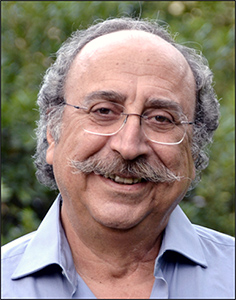 When people ask me to name my favorite place of worship, I can never offer a single answer. The truth is, I have three “favorites” that differ greatly in terms of age, style and physical location. Each has contributed to the “geography of the spirit ” I’ve traveled over a lifetime and embodies qualities that echo my humanity and the contents of my faith. I imagine them as places where I have encountered in unique ways all three persons of the Trinity—Father, Son and Spirit—whose divine supervision of me has proven such a blessing. What follows are some simple descriptions of the circumstances surrounding these encounters.
I—The Place of My Childhood Encounter with “The Beyond in the Everyday”
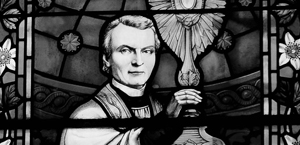
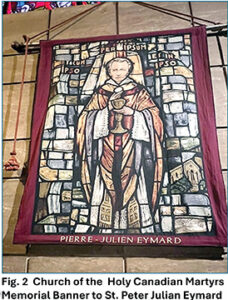
My geography of the spirit begins at Rome’s Church of the Holy Canadian Martyrs (figs. 1-3), whose construction was completed in 1955. Soon afterward (1962), the church was entrusted to the Congregation of the Blessed Sacrament just as its founder Peter Julian Eymard (1811-68) was being declared a saint.
I was a child of five or six years old when my father first brought me here. At the time, he was not a practicing Catholic, but he possessed a great enthusiasm for the sacredness of certain places. He had discovered this modern temple, so unlike most of the Roman buildings surrounding it, but capable of evoking from visitors its own set of reactions. Though the church was constructed in the years just prior to Vatican II, its design prefigured much of what the council fathers would eventually have to say about the architectural environment for sacred liturgy.
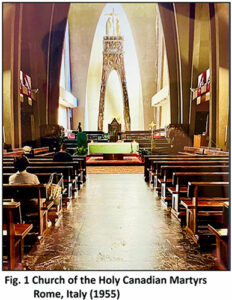
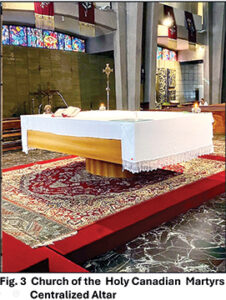
Growing up, I intuitively understood the meaning of the structure’s central hall, or nave, which was dominated by five, double-large parabolic arches supporting a vaulted ceiling. The height of the latter contributed to the church’s impressive vertical dimension and encouraged worshipers to gaze upward, to the summit of the great canopy that hovered over its altar. The canopy was crowned by a three-dimensional depiction of the Crucifixion, which my young mind interpreted as a glimpse of “the Beyond.” Overall, the emotional effect of the church’s interior—a religious classroom to me—flowed from asymmetry, a game of mirrors causing worshipers to look upward, then downward, even while being washed from both sides by light from a number of multicolored windows. Architecture, it seemed to me, was able to give way to revelation in a church like this, which simultaneously suggested that the Crucified Christ was literally “up there” and unreachable but so close as to be sitting just beside me.
Through the authenticity and simplicity of its form, the church could be said to echo the message of Gospel. Within it, we are moved to reflect on how the difficulties suffered by the Son of Man are the same that confront all of humankind, even today. Its structure also encourages us to remember the sacrifice of the martyred priests to whom it is dedicated, whose spirits continue speak to us powerfully in this place. Here we may contemplate the toil of human flesh, which our God so freely assumed.
II—A Place of Encounter with the The Holy Spirit, the “Breath That Elevates”
From the flesh of the Son, a pathway can open for believers to the breath of the Holy Spirit. For me, this mystery has most clearly assumed architectural form at the Cistercian Abbey Church in Fossanova, Italy, a short distance from the country’s popular Circeo National Park, in the Province of Latina. Consecrated in 1208, this jewel of Cistercian Gothic design exudes an aura of absolute spirituality. Inside, the structure becomes pure narration: the dizzying heights, the naked power of the stone and the play of light contribute to a transition from the density of the earth to the weightlessness of the sky.
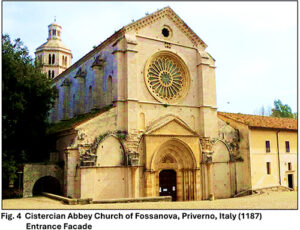
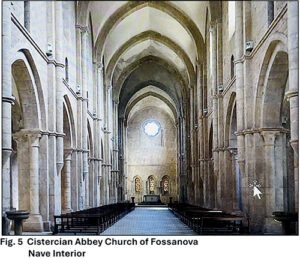
I got to know this place in my late teens, back in 1972, during a special time spent with the Scout Troop to which I belonged and the monks of the abbey. One evening, after dinner with the monks, I sought solitude in the darkness of the church, in whose apse I found an organ. The moment is forever etched in my memory. I sat down at the instrument and spontaneously started playing as a means of contemplation through music. I played a range things, from some Baroque melodies of Bach to the Modernist works by the French organist and composer, Jehan Alain. I even performed a personal reworking of A Salty Dog, a well-known, organ-heavy tune of the time by the popular English rock group, Procol Harum.
As I played in the darkness of the church that evening, I began to realize that people were beginning to fill its pews. They sat apart from each other but were united in their experience of silently listening to my “musical prayer.” Then, through the large rose window high on the building’s western wall, a beam of moonlight entered the church, illuminating its ancient stone floor like a spotlight. At that moment I was playing and praying—or perhaps I was praying because I was playing. My response to the moment was immediate and fully human. But the sight of the light, combined with the sound of the music and the general atmosphere within the centuries-old nave, struck me as entirely divine.
It is said that music can elevate the soul. The same goes for architecture, which the 18th-century German philosopher, Goethe, famously described as “frozen music.” I learned the truth of these ideas that night in the abbey church. To this day, whenever I feel the need to lift my spirits, a visit to this place does the trick. In its harmonic merging of art and the breadth of immensity, the church links my humanity with the infinite, and my faith recognizes the Holy Spirit as the invisible “breath” that expands the heart.
III—Arriving at the House of the Father, Our Original Caregiver
My spiritual journey through life comes full-circle at the Parish Church of San Giovanni Battista in Molli, an 11th-century Romanesque structure overlooking the Tuscan village of Sovicille that I regard a “Dwellingplace of Our Divine Father.” The church’s interior is extremely austere. Unpainted walls of stone carry the exposed trusses, rafters and decking boards of a wooden ceiling, beneath which, in the apse, hangs a rustic crucifix. The entire building evokes an air of prayerful simplicity.
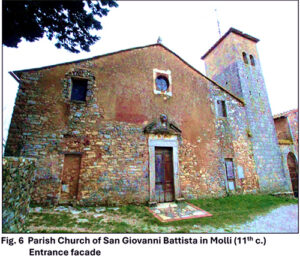
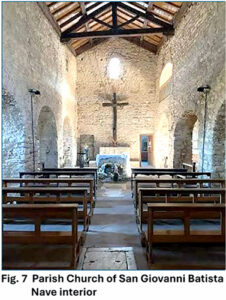
A special memory I have of San Giovanni stems again from my involvement with Scouting here in Italy, this time as adult leader of a group of Wolf Cubs, roughly eight years of age, whom I had led to the church. On the occasion I hold as precious, my young Cubs were sitting cross-legged in a semicircle on the church’s floor. As they did, a ray of sunlight passed through one of the building’s oculus windows, enwrapping them and reflecting off the particles of dust floating around them like tiny jewels.
The moment was magical and added to the religious instruction on the nature of guardian angels my fellow Scout leaders and I had prepared for the boys. Our point was to assure them that God, our Father, takes care of us from the time we are very young. The parish church in which we were gathered, so small and poor but filled with the bubbly vitality of children, struck me as a place where the fatherly presence of God was close-by. A young father myself, I sensed that God was speaking to me directly. Just as my father had once shown me how to appreciate the sanctity of a space, so I was now training another generation to do likewise. My hope was that the young Cubs in my care would not imagine God as distant sovereign but as a loving Father who guards, educates and warms their beings.
The earth-bound journey of the spirit I describe here may well have seemed to rely on three “way-stations” to which I attach special significance. Its general direction, however, has been as unwavering as my desire for union with the heavenly Trinity, in whose embrace my soul will finally feel at home.
Download a pdf version of this article here.
©2026 Emmanuel Magazine, Congregation of the Blessed Sacrament
All rights reserved.
Readers may reach editor Michael E. DeSanctis at editor@blessedsacrament.com and by mail at Emmanuel Magazine, Editorial Office, 220 Seminole Dr., Erie, PA, 16505.