



What Is the Eucharist?
Dolores L. Christie
Editors’ Note: Emmanuel Magazine is happy to offer its readers this reflection on the nature of eucharistic prayer by Dolores L. Christie, Ph.D., a longtime clinical ethicist and college professor, whose writing frequently addresses the intersection of faith and science. She is author of Last Rights: A Catholic Perspective on End-of-Life Decisions (Sheed and Ward, 2003) and Moral Choice: a Christian View of Ethics (Fortress Press, 2013) and has served as Executive Director of the Catholic Theological Society of America. Currently, Dr. Christie is a member of the chemical dependency committee for the Ohio Solid Organ Transplant Consortium and the ethics committee of the Hospice of the Western Reserve affiliated with Case Western Reserve University. She writes from Shaker Heights, Ohio, where she and her physician-husband make their home. MED
 What is the Eucharist? We may imagine a “thing,” a mysterious piece of bread or sip of wine that in some way is a prize, a gift for the good. If we are “good,” we receive, we consume, we return to our pews. We are satisfied.
We create rubrics to emphasize this meaning, with insistence on clean hands, instructions to bow, to use special words in the exchange, to return the ciboria to the priest with special care and lock away the remains in a golden box.
Perhaps that is not the correct lens. If we return to the Scriptures for insight, what do we find? The synoptics have an “institution” narrative. Jesus, at his last meal with the apostles, calls the bread his body and the wine his blood. His final words to his followers are: “Do this in memory of me.” The questions to ask is, “What does this mean?” Is this a command to perform a ceremony, or is it something more?
We find the answer in the last chapter of Luke and Jesus’ final meal before the Crucifixion recorded in John. What happens when the clueless participants, traveling away from the city of Jesus’ death, “recognize him in the breaking of the bread” (Luke 24: 13-35)? Then the guest disappears; the others run back to Jerusalem to recount what they experienced. The story evokes also the Samaritan woman at the well who, having avoided neighbors in the past, rushes to spread the word of her encounter. It reminds the reader of the women at Jesus’ grave who rush to announce the missing body.
In John there is no institution narrative. The late Blessed Sacrament priest and scholar, Joseph Nearon (1928-1984), was accustomed to arguing that Chapter 6 in John is the institution narrative. There is no formal dinner, no formulaic words. There is only the connective tissue of Jesus sharing by his own hands the multiplying bread originally proffered by the prudent and generous folks who brought lunch: the connected community at work.
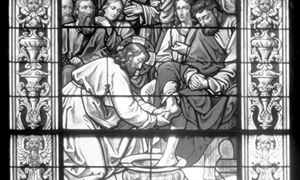
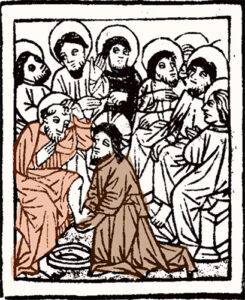 In the Last Supper story in John, two things stand out. First is the washing of the feet. Jesus, the leader, who knew he was about to die, takes on the role of a servant. He goes further by intentionally offering bread to the man he knows will betray him. Such modeling of humility and forgiveness! Jesus lingers at the table, rather like a priest whose homilies go on and on. There is, however, a serious message in the lugubrious metaphors he offers. “I will not be here any longer, but you are the branches to my vine.” “Your task is no longer passive but active.” “You must bear the fruit that I provide.”
At the Last Supper . . . [Jesus] . . . the leader, who knew he was about to die, takes on the role of a servant. He goes further by intentionally offering bread to the man he knows will betray him.
The divine example of vulnerability and brokenness we see in Jesus is not a performance to be watched but an example to be copied. To embody this example in our lives means pain. “You will be hated by all on account me of me” (Matthew 11:22). Yet, even in our darkest moments, God’s love is there, along with the pulse in the vine that produces the fruit of our lives. Why are we slow to embrace this?
Recognizing Christ in the breaking of bread or the reception of the Eucharist is not an invitation to pray privately or to gape at the activity unfolding before us. Neither is it solely an encounter with a minister who dispenses a host to us. It consists in the daily washing of the feet of a complaining relative whose process of dying proceeds more slowly than anticipated. It’s reflected in the smile we give to a person of another color who walks by us on the streets. It is the daily rising and responding to the task of doing good. It is a serious and urgent and enduring call, particularly in today’s world of hate, to become what we eat. We must remember that and continue to ask what that means.
Download a pdf version of this article here.
©2026 Emmanuel Magazine, Congregation of the Blessed Sacrament
All rights reserved.
Readers may reach editor Michael E. DeSanctis at editor@blessedsacrament.com and by mail at Emmanuel Magazine, Editorial Office, 220 Seminole Dr., Erie, PA, 16505.