



 Emmanuel is pleased to present this pair of book reviews by Alison M. Benders, J.D., Ph.D., former Associate Dean and Senior Lecturer at the Jesuit School of Theology of Santa Clara University. Dr. Benders’ research addresses questions regarding racial privilege and social oppression. She publishes widely and is the author of Just Prayer: A Liturgy of Hours for Peacemakers and Justice Seekers (Liturgical Press, 2015), which received the 2016 Catholic Publishers Best Book Award for Spirituality.
________________________________
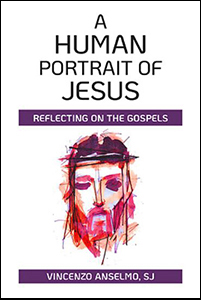 A Human Portrait of Jesus: Reflecting on the Gospels
Vincenzo Anselmo, SJ.
Paulist Press,
Mahwah, NJ,
2026.
A Human Portrait of Jesus: Reflecting on the Gospels offers a rich feast for reflection to help readers understand Jesus’ humanity within first century Palestine, an era of conflict just like our own. The author, Jesuit priest Vincenzo Anselmo, connects us with the major emotions that Jesus and those who encountered him experienced by adhering closely to the gospel narratives and texts. Throughout the graceful text, the succinct chapters present vignettes and portraits of Jesus fully engaged compassionately and vibrantly with both his followers and his detractors. While the author’s prose is simple and straightforward, his observations are evocative and compelling. This is not scriptural exegesis, but an invitation to readers to deepen their prayer lives by strengthening their emotional connection with Jesus as a person who experiences joy, trepidation, and affection in profoundly human ways.
Anselmo addresses the humanity of Jesus by giving attention to each of the four Gospels in turn. In the Gospel of Mark, subheadings in the chapter highlight Jesus’ love, address his negative emotions, and invite readers to savor his joys and tears in the trials of human life. The discussion of Luke, in contrast, carefully follows the Gospel’s chapter structure to lift up the predominant emotional valence in the events of Jesus’ birth, ministry, passion, and resurrection. For example, Luke Chapter 9 retells Jesus’ journey to Jerusalem. The author points out that the episode “begins by projecting a solemn and resolute image of Jesus – “the hardening of his face” – and ends with the Messiah weeping over Jerusalem” (30). The book presents a parallel chapter by chapter discussion of Matthew’s Gospel, enabling us to comprehend and embrace the implications of Jesus’ emotional vulnerability. Chapter 26 and 27 narrating Jesus’ passion are particularly poignant: “[On the cross] Jesus shouts and prays and pronounces the beginning of Psalm 22, expressing the state of abandonment in which he finds himself” (65). These powerful descriptions will root themselves in readers’ hearts as they contemplate the depth of divine love as Jesus laid down his life for humanity’s redemption. Finally, in explicating the Gospel of John, the author segments the narrative according to Jesus’ emotions, such as vulnerability and love for his disciples. By elevating human-divine love, this approach comforts readers because “it is only through love that we can come to know, and penetrate the mystery of God made flesh, who comes into the world” (81).
The author’s penetrating observations add as much meaning and guidance for readers as does his selection of pivotal texts to invite us into comprehend the Incarnation in new ways. In discussing various passages, gems of poignant wisdom frame discussion of emotionally charged conversations. For example, in discussing Simeon’s prophesy to Mary when she and Joseph present the baby in the temple, i.e. that the infant is destined to be the fall and the rise of many in Israel (Lk. 2:34–35), Anselmo writes: “The metaphors of the heart and the soul as a place of interiority announce an internal battle, where the acceptance or otherwise of Jesus is at stake. The heart is the main battlefield” (20). This insightful language both frames the challenge of faith and points out a path forward by helping readers connect their hearts and their lives with Jesus Emmanuel (God-with-us).
The invaluable contribution of A Human Portrait of Jesus is to invite readers to love and follow Jesus more faithfully because they recognize the depths of the heart that he shares with all humanity. By tracing the salvation story from Jesus’ birth, through his ministry, to his passion, death, and resurrection, we more easily come to know Jesus in his full human dimensions. Accessible and engaging, the book offers an ideal text for parish and community faith sharing, particularly in Lent. Participants will experience the fullness of Jesus’ humanity as a challenge to and support for their faith. Assured in the author’s own voice, they will experience that “[t]he words of Jesus – even the harshest and most severe – are the Gospel, the good news for the disciple of yesterday and today who is invited to choose life always” (92).
________________________________
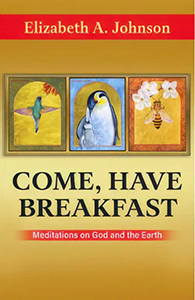 Come, Have Breakfast: Meditations on God and the Earth
Elizabeth A. Johnson.
Orbis Books,
Maryknoll, New York,
2024.
Elizabeth A. Johnson represents her purpose for Come, Have Breakfast: Meditations on God and the Earth: “[T]he meditations in this book try to decipher the heart of God toward creation in order to widen our minds and hearts for ecological care” (ix). Each of the 30 meditations, which walk us through major themes in Christian tradition, might stand on its own as a hymn of praise and a heart prayer that voices her (and our) wonder at the magnificence of the cosmos: all that is, all that lives and breathes. She successfully presents a “panoramic view of the living God who loves planet Earth and accompanies all its inhabitants” (xii). Johnson’s deeply developed theopoetical throughline presents God’s faithful intimacy with and continuous joy in the ever-emerging newness of creation.
The introduction offers a helpful explanation of the work’s structure. The collection is not a treatise or a discursive argument, but a series of reflections to invite readers to savor the multiple dimensions of relationship between creation and the divine Giver of Life. The scripture passages that bookend each entry lend themselves, as versicles, to be committed to memory to nurture ecological care. The spiritual and theological reflections incorporate naturally and holistically one or more biblical references, drawn from nearly every significant New Testament or Old Testament book as well as beloved psalms. The individual meditations are clustered to align with evocative themes, such as God‘s vivifying presence; Jesus and the Earth; and “humankind and other kind.“ Johnson’s principal dialogue partner beyond scripture, is Pope Francis, particularly the message in his powerful encyclical Laudato Si’. However, references to Hildegard of Binged, Saint Augustine, and Julian of Norwich as well as contemporary thinkers like Denis Edwards, Karl Rahner, and Shawn Copeland abound to develop emerging understandings of evolution and human community.
The book’s title and closing meditation reference the resurrected Jesus‘ invitation at John 21:12 on the morning of the resurrection at the sea of Galilee. Having prepared breakfast on the beach for his fishermen-apostles, who had just hauled in an enormous catch, Jesus reveals himself by inviting them to share a breakfast of roasted fish, recapitulating the divine nurturing care that they had experienced for themselves throughout his ministry. Here Johnson specifically links the praise of Psalm 145: “[T]he eyes of all look to you, and you give them their food in due season, you open your hand, and satisfy the desire of every living thing“ (Psalm 145:15–16). However, Johnson reminds the reader throughout the reflections that God is not the only creator or sustainer of life in the cosmos; humanity ought rightly to understand itself as, with the Divine, co-creators and co-carers for the earth. She repeatedly notes, however, that Christianity’s salvation story has too often relegated nature to serve as a backdrop or inconsequential stage for humanity’s egoistic projects. The fourth meditation, “A suffering world,” highlights the disjunction between God‘s faithful and joy filled care for creation with suffering, both natural and cruelly imposed. The meaning (or meaninglessness) of suffering is a red thread woven into the creation drama itself, she offers. Convinced that all goodness is preserved in the heart of the Divine, this particular reflection invites readers to consider their own context, struggle, suffering, and eventually death as a part of the seamless, continuous creation for the glory of God.
Many contemporary Christians serious about ecological care, as well as their dialogue partners from other traditions and spiritualities, can find nourishment in Come, Have Breakfast. Johnson shows how the convictions shared by humanity’s traditions can be deepened by understanding that the hope of a living thriving earth demands our most urgent and cooperative care. Parish and retreat groups looking for seasonal inspiration, particularly to accompany justice initiatives, can savor the meditations to inspire projects connected to healing the land and water.
Very simply, Come, Have Breakfast is a project inviting ecological conversion and concerted action by all of us as co-creators of the earth cooperating with the divine Hope. I cannot urge readers strongly enough to taste for themselves this collection of meditations on God and the Earth, composed with soaring grace, inspiring prose and exquisite scripture passages. Readers will find that their hearts will both rejoice in God, the Giver of Life, and ache to nurture the cosmos “in which we live and move and have our being.”
Download a pdf version of this article here.
©2026 Emmanuel Magazine, Congregation of the Blessed Sacrament
All rights reserved.
Readers may reach editor Michael E. DeSanctis at editor@blessedsacrament.com and by mail at Emmanuel Magazine, Editorial Office, 220 Seminole Dr., Erie, PA, 16505.