




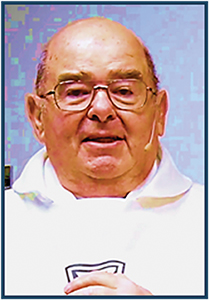
 Editor’s Note: Emmanuel Magazine is pleased to offer this opinion piece on the nature of the Church and its members by Rev. John J. Roche, a priest of the Congregation of the Sacred Hearts of Jesus and Mary (SS.CC.) residing in retirement in LaVerne, California. Ordained in his native Ireland in 1972, Father Roche has devoted his priesthood to leprosy rehabilitation in India, prison ministry in various locations throughout the United Kingdom, and to parish work in Ireland, England and the United States. Now retired, Father enjoys writing on theological topics, trying his hand at photography and listening to traditional Irish music. MED
You Are Peter
Rev. John J. Roche, SS.CC.
We have all read multiple tracts and heard numerous sermons on how the Church was founded on the rock of St. Peter. But how solid a rock was he? He didn’t prove to be a very steady rock to the charcoal brazier in the high priest’s court the night Jesus was arrested (Luke 24: 54-62), nor on the occasion when Jesus rebuked him for his untrusting ways with the words, “get behind me Satan” (Matthew 16:23; Mark 8:33).
So how solid a rock is Peter?
Maybe Jesus had a different kind of rock (or a different type of strength) in mind. For example, diamonds, which are certainly rocks, can be striking and highly valued. So maybe Jesus was imagining Peter to be a diamond—a diamond in the rough, one might say.
A Church Built of Rough Diamonds
Jesus views us all as “rough diamonds” that need our edges polished smooth. Just like Peter, we have ample room for refinement. The Church is made up entirely of rough diamonds—unfinished, coarse, jagged-edged and in need of some polishing if we’re ever to become sparkling gems. The Lord loves his diamonds and wants all of them to be refined by the words of the Gospel. He wants even the most imperfect of stones to be brought to their glory. The Lord himself was a “cornerstone rejected by the builders” (Matthew 21:42; Mark 12:10–11; Luke 20:17), but in the way he builds his church, no stone is rejected.
The Church may be conceived as one, spectacular diamond that reflects the life and light of the Lord and his gospel, a beacon of light in a dark world. It is a gem that has been tarnished at times, because, like any diamond dug from the ground, it is imperfect. Filled with imperfections as it is, however, the Church has stood the test of time and fulfilled its mission of bringing people together to be fed by the Lord in word and sacrament.
To whom shall we go?
Some followers of Jesus found what he said particularly about the sacrament of the Eucharist to be unpalatable and so departed from his group. Jesus asked those who remained whether they too wished to leave him. To this question, Peter responded, “to whom shall we go” (John 6:68). If any of us today wishes to leave the Church, we must likewise ask ourselves, “to whom shall we go.” Is there another church founded by Christ to which we might belong?
Some go so far as to dispense with belief in God and religious faith altogether. A major reason why people walk away from religion is that they regard it an emotional crutch held over from earlier and more superstitious times. They insist God is intellectually superfluous, owing to the fact that modern science, philosophy, medicine, etc. are able to explain the nature of existence without the need for a divine creator. They also maintain that God is emotionally dispensable, which is to say that educated people have no need to remain tied to God’s apron strings but can think and act for themselves. A final reason many jettison God from their lives is that they regard belief in him to be morally intolerable. How, they ask, can a heavenly creator who is the author of love allow his creators to suffer as we do?
The Enlightenment thinkers of the late-17th through early-19th centuries gave the world a “clockmaker God” conceived as creating the universe, winding it up, then sitting back with detachment as it ticked away. Wide acceptance of such theologizing in the West eventually caused God to fade from people’s consciousness, like the Cheshire cat in Alice Through the Looking Glass, and reappear only when science, medicine or psychology failed to answer their deepest, existential questions. Increasingly God was dismissed as a prop for the weak and dependent, and religion, in Karl Marx’s famous estimation, as das Opium des Volkes” (an “Opium of the people”). In a way reflective of the mindset of our post-Enlightenment culture, comprised in great numbers of what Jesuit theologian John Courtney Murray (1904-67) called “the Godless [people] of the marketplace,” my own cousin once told me he had “too many important decisions to make to think about how God could possibly help me.”
If One Leaves the Church, Then What?
If one rejects the Church because it is not perfect, can another be built in its place? The defects in the Church, after all, are the same ones we have in ourselves. All of us are rough diamonds, full of imperfections. Nothing we create is completely flawless. Was the Church of yesterday better than that of today? Was the Church in the apostle’s time?
We have only to return to the example of Peter, who was there at the Church’s founding, to appreciate how duplicitous we followers of Jesus can sometimes be. Paul’s Epistle to the Galatians, for example, confirms that Peter, while living in Jerusalem, was in the habit of dining with gentiles. He immediately changes his ways when confronted by members of a circumcision party led the Apostle James, a mark of hypocrisy for which Paul in turn calls him out “to his face” (Galatians 2:11–12). Yet, despite his many imperfections, Peter is the one Jesus chooses to be the foundation stone of his church.
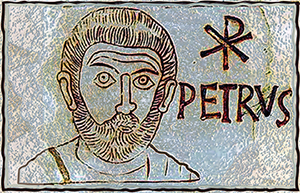 Unlike other human institutions, the one built around this rough diamond is imbued with a supernatural and holy personality. It therefore exists as an impenetrable mystery held together by the cementing love of the Holy Spirit. Its members may be groping in the darkness and fighting daily against the temptation of losing their faith. They may be riddled with sanctity and sin, courage and weakness, and constantly aware of our imperfections. In this, however, we mimic Peter, upon whom Christ himself chose to construct his church.
Conclusion
Some today argue that the Church must be more “credible”—but to whom? Must the Church legitimize itself to those who don’t believe in God? The mystery of the Church is the same as the mystery of Christ. Its credibility is apparent to those who believe in Christ, because it is his church first and foremost—his own continuation and fullness. The Church is credible because for over two thousand years, despite the many imperfections of its rough diamonds, it has preserved the faith, which includes faithfulness to the Eucharist. In every celebration of the Mass we hear the words, “this is my body” and “this is my blood” which invite us to enter into communion with our Lord Jesus Christ.
To whom else could we possibly wish to turn but the Christ who promises us enteral life (John 6:68)?
Download a pdf version of this article here.
©2026 Emmanuel Magazine, Congregation of the Blessed Sacrament
All rights reserved.
Readers may reach editor Michael E. DeSanctis at editor@blessedsacrament.com and by mail at Emmanuel Magazine, Editorial Office, 220 Seminole Dr., Erie, PA, 16505.