




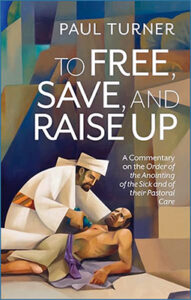
 To Free, Save, and Raise Up: A Commentary on the Order of the Anointing of the Sick and of their Pastoral Care
Paul Turner
Collegeville: Liturgical Press
2026
Annually, we have come to expect an excellent commentary on the latest revision of a liturgical rite in the Roman Catholic Church. This year, Rev. Paul Turner, a priest of the Diocese of Kansas City-Saint Joseph, Missouri, who pastors its cathedral church and directs its office of worship, has offered us practical guidance in navigating the second edition of the Order of the Anointing of the Sick and of their Pastoral Care (PCS). Roman Catholic publishers printed the new edition and copyrighted it in 2025. It has become mandatory on Easter Sunday, April 5, 2026.
As with his other series of commentaries from Liturgical Press, Father Turner takes the previous ritual texts and is in a “dialog” of sharing what was original, in this case from 1614 Roman Ritual, what was temporarily done or a pastoral exposure (i.e., the Lourdes, France communal anointing texts of 1969), the first English edition of the text (1983), and the current ritual, now of 2025. He also uses primary resources from the Second Vatican Council and its Consilium (the Schemata text the council used as it developed the ritual after its sessions), Annibale Bugnini and his Reform of the Liturgy, and A.G. Martimort, to name the most prominent in this tome. Together these resources, here in one volume, offer readers an opportunity to see where the ritual began and how it has developed since the Council of Trent.
I really appreciated many parts to this book and the careful selection of history Turner uses from the liturgical texts. I appreciate his specific postscript on “last rites” and the misnomer that label is with for this sacrament. (I would have even gone further as I do in my pastoral conversations and experiences by saying that there are no such things as “last rites” since the person will have a funeral Mass, Mass intentions for their life and death, and be around the table of the banquet in heaven where there is constant ritual with our Savior.)
Turner highlights in a very subtle way the improvements and the lack of items that did not carry over from 1983 to the present text. Some are a disappointment; some of the reorganization has been difficult for those most comfortable with the previous ritual book. Turner reminds us, even though the ritual book is heavy on the priest being the primary minister, that there are parts for deacons and lay ministers when it comes to ministry to the sick and dying. Viaticum is largely ignored by many, and this ritual, with anointing, is the primary in accompanying the person to their eternal reward. (This minister and author have been negligent in bringing Holy Communion when possible to the dying, I must confess!)
Turner is quick to point out the important pieces, including the pastoral needs, that must not go unmet for those eligible for the sacrament. In some cases, when someone has only received baptism and not confirmation, the ritual must be celebrated with Confirmation, Penance, Anointing of the Sick and Viaticum, all in one ritual. Yes, all are called to be celebrated together—four sacraments. How often is this forgotten by priests in their care of the sick, not asking helpful questions. Page 153 highlights the importance of Confirmation in danger of death, something that is not a common thought or pastoral question that is asked of families.
One thing that should be noted: deacons and lay ministers need to inform their pastor of their ministry with a sick or dying person (see page 103) and there should always be a collaboration between pastoral staffs, nursing facilities and/or hospitals so that there is proper sacramental ministry and it may be shared. Furthermore, Turner reminds us of the need to do this sacrament in tandem with the other rituals found in Holy Communion and Worship of the Eucharistic Mystery outside of Mass (HC). There is hope that the USCCB will provide an excerpt edition of the HC and PCS together for lay ministers: let’s pray for that gift to assist in this important ministry of healing and care.
Turner begins his introduction by quoting James 5:14-16 that gives the liturgical sacrament’s antecedents. It’s a good way to remember the simple but very profound way the church ministers to those in vulnerability and need when they are ill, elderly or in need of physical, spiritual and emotional healing. While Turner makes some of us long for a better 1983 edition that is not the 2025 edition, by reminding us of the key omissions, his background with the history, liturgical creation of the current text and his pastoral observations, guide us to embrace the 2025 edition of this important ritual. May our purchase of this book, in tandem with the new ritual text, deepen our appreciation and care of this saving sacrament and lift up those in need to feel the power of Christ heal them.
John Thomas Lane, SSS
Provincial Superior of Saint Anne Province
Publisher Of Emmanuel Magazine
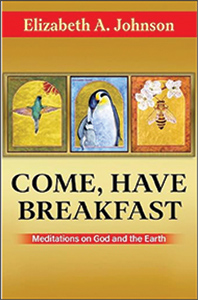 Come, Have Breakfast: Meditations on God and the Earth
Elizabeth A. Johnson
Orbis Books
Maryknoll, New York
2024
Elizabeth A. Johnson represents her purpose for Come, Have Breakfast: Meditations on God and the Earth: “[T]he meditations in this book try to decipher the heart of God toward creation in order to widen our minds and hearts for ecological care” (ix). Each of the thirty meditations, which walk us through major themes in Christian tradition, might stand on its own as a hymn of praise and a heart prayer that voices her (and our) wonder at the magnificence of the cosmos: all that is, all that lives and breathes. She successfully presents a “panoramic view of the living God who loves planet Earth and accompanies all its inhabitants” (xii). Johnson’s deeply developed theopoetical throughline presents God’s faithful intimacy with and continuous joy in the ever-emerging newness of creation.
The introduction offers a helpful explanation of the work’s structure. The collection is not a treatise or a discursive argument, but a series of reflections to invite readers to savor the multiple dimensions of relationship between creation and the divine Giver of Life. The scripture passages that bookend each entry lend themselves, as versicles, to be committed to memory to nurture ecological care. The spiritual and theological reflections incorporate naturally and holistically one or more biblical references, drawn from nearly every significant New Testament or Old Testament book as well as beloved psalms. The individual meditations are clustered to align with evocative themes, such as God‘s vivifying presence; Jesus and the Earth; and “humankind and other kind.“ Johnson’s principal dialogue partner beyond scripture, is Pope Francis, particularly the message in his powerful encyclical Laudato Si’. However, references to Hildegard of Binged, Saint Augustine, and Julian of Norwich as well as contemporary thinkers like Denis Edwards, Karl Rahner, and Shawn Copeland abound to develop emerging understandings of evolution and human community.
The book’s title and closing meditation reference the resurrected Jesus‘ invitation at John 21:12 on the morning of the Resurrection at the sea of Galilee. Having prepared breakfast on the beach for his fishermen-apostles, who had just hauled in an enormous catch, Jesus reveals himself by inviting them to share a breakfast of roasted fish, recapitulating the divine nurturing care that they had experienced for themselves throughout his ministry. Here Johnson specifically links the praise of Psalm 145: “[T]he eyes of all look to you, and you give them their food in due season, you open your hand, and satisfy the desire of every living thing.“ (Psalm 145:15–16) However, Johnson reminds the reader throughout the reflections that God is not the only creator or sustainer of life in the cosmos; humanity ought rightly to understand itself as, with the Divine, co-creators and co-carers for the earth. She repeatedly notes, however, that Christianity’s salvation story has too often relegated nature to serve as a backdrop or inconsequential stage for humanity’s egoistic projects. The fourth meditation, “A suffering world,” highlights the disjunction between God‘s faithful and joy-filled care for creation with suffering, both natural and cruelly imposed. The meaning (or meaninglessness) of suffering is a red thread woven into the creation drama itself, she offers. Convinced that all goodness is preserved in the heart of the Divine, this particular reflection invites readers to consider their own context, struggle, suffering, and eventually death as a part of the seamless, continuous creation for the glory of God.
Many contemporary Christians serious about ecological care, as well as their dialogue partners from other traditions and spiritualities, can find nourishment in Come, Have Breakfast. Johnson shows how the convictions shared by humanity’s traditions can be deepened by understanding that the hope of a living thriving earth demands our most urgent and cooperative care. Parish and retreat groups looking for seasonal inspiration, particularly to accompany justice initiatives, can savor the meditations to inspire projects connected to healing the land and water.
Very simply, Come, Have Breakfast is a project inviting ecological conversion and concerted action by all of us as co-creators of the earth cooperating with the divine Hope. I cannot urge readers strongly enough to taste for themselves this collection of meditations on God and the Earth, composed with soaring grace, inspiring prose and exquisite scripture passages. Readers will find that their hearts will both rejoice in God, the Giver of Life, and ache to nurture the cosmos “in which we live and move and have our being.”
Alison M. Benders
Jesuit School of Theology, Santa Clara University
Download a pdf version of this article here.
©2026 Emmanuel Magazine, Congregation of the Blessed Sacrament
All rights reserved.
Readers may reach editor Michael E. DeSanctis at editor@blessedsacrament.com and by mail at Emmanuel Magazine, Editorial Office, 220 Seminole Dr., Erie, PA, 16505.