

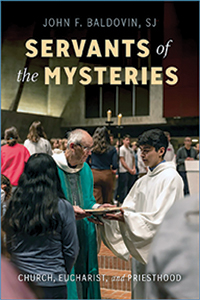
 Servants of the Mysteries: Church, Eucharist, and Priesthood
John F. Baldovin, SJ
Collegeville: The Liturgical Press
2026.
Jesuit Father John Baldovin is known for his great works, and this volume does not disappoint. The first part of this book consists of new writings from him, while the later chapters are reprints/reworkings from previously published articles or lectures he has given. For those wishing a good, theological and historical basis for servant leadership of the ordained priesthood, and the connection of that with the Eucharist, this work delivers.
Some will say that there has been a lack of serious writing and study on the sacramental role of the ordained priest, especially as concerns the Eucharist. Baldovin’s study examines the assembly of the baptized as the active subject of the Eucharist and the ordained serving the members of assembly—the Body of Christ. This reality of the theology, history and liturgical roles of the ordained delves into the Paschal Mystery, the essence of our shared relationship in Christ. Cultures that have doubled down on an elevated theology of the ordained priesthood would be wise to have this added to their curriculum as the next paragraph will demonstrate.
There are excellent footnotes that Baldovin’s work and research provide. This allows this book to be paramount in citation of the Roman Catholic ordained ministry and not a cultic view held by a new generation not open to learning the Church’s traditions. Baldovin hopes to integrate the teachings and theology of the Second Vatican Council for the ordained priesthood, church ministry and especially the Eucharist. He gives plenty of opportunities, with some effort. He also cites one of my pet peeves at Mass and even uses the words on page 29: “Why do we not care if the people receive from the reserved hosts in the tabernacle [since the priest is forbidden to]?” He also argues, directly from the documents of the Church, how the model of ordained ministry, especially in serving with the sacraments, has radically changed over time. Some of the actions of the priest during Mass do not reflect these changes. He goes into detail on the parts of the Mass, especially the Eucharistic Prayer and why, how and what the priest is doing during this vital ministry. This material would be helpful for reflection during a priest retreat.
Baldovin addresses a few controversial issues that are resurfacing today and presents the Church’s official position on them, for example, whether a priest should station himself versus populum or ad orientem while presiding at Mass. The later, he argues, does not serve the assembly but is ultimately self-serving. It is of little value to those men wishing to function as priests of the Roman Rite today, when certain models of ministry and service prevail.
In his conclusion, Baldovin reiterates ten issues and styles that are not consistent with the theology of the Church. Again, for the ordained priest, it is so valuable for this list to be reviewed, studied and for the ordained priest to adapt to our modern theology of the priesthood. The author’s fundamental message is that as priests we are about service. While this is outstanding, the reason why certain topical chapters were included in this book was not entirely clear. Nevertheless, everyone studying to be ordained to the Catholic priesthood should read this book and get ready to practice and serve the people of God and our liturgy. Likewise, those already ordained might wish to bring this book along on a silent retreat to read and mediate often on how they might grow in witnessing the Body of Christ to the Body of Christ.
John Thomas Lane SSS, Liturgical Consultant, Pastor and Provincial
Église Saint Jean Baptiste
New York, NY
The Catholic Church and the Foundations of Public Administration:
A Study of Continuity, Governance, and Institutional Endurance
Joseph M. Casamatta
Self-Published Book
Copell, Texas
2026.
Anyone involved as an engaged volunteer or minister-employee knows that there are layers to learning the Roman Catholic Church’s systems. There is a plethora of unique vocabulary and operating systems that guide how the church serves and administers its life and ministry. Canon Law and other documents molding the Church’s structure have not been readily available in the form of a “user manual.” Until now!
In a wonderful turn of a vocation in the armed services, Joseph M. Casamatta has given us an “owner’s manual” based on his own experience of military manuals to create a study of the Church’s institutional administration. For each person studying to serve and/or work in the Church, especially at the parish level, or those already in service to the church, this tome is outstanding in putting together the foundational principles that have made the Church the grand institution it is. Both of us would write “grand,” since the Church was to codify and develop laws and structures that assisted societies and cultures organize themselves too.
“The church is a rare institution,” Casamatta writes on page 111, with the development of administration to guide how it serves itself and others. It is important we study this institution and how it governs and serves. Repeatedly Casamatta analyses and reports on the contributions in the study of public administration that are helpful for knowing how the Church is and serves for others. Casamatta’s style is brief but very engaging as he simply gives history and details to tell the story of how the Church grew into its administrative ways. One item that could be further developed for his second edition, when this first one should go out of print, is a new structure that Pope Francis rebirthed and Pope Leo XIV has asked for the Church to continue: synodality. This is a revised structure for the Church’s rebirth in the 21st century and needs to be shared and detailed to assist parishes and dioceses in following the structures of the synods on synodality that have trickled both up and down the “the chain of command” to be the “new” style of listening and walking with one another in the church’s life and administration. This might even be a separate book or chapter to give the structures and strategies of synodality.
Four contributions of the Church’s administration carry this work forward. Your reading of this book will affirm and assist you in teaching others the Church’s ministry structures and guiding parish leadership. What a great gift to share with those in parish leadership! What a great resource to read to move into the Church’s service for those training to be ministers of the Church implementing its ministry and governance.
John Thomas Lane SSS, Liturgical Consultant, Pastor & Provincial
Église Saint Jean Baptiste
New York, NY
Download a pdf version of this article here.
©2026 Emmanuel Magazine, Congregation of the Blessed Sacrament
All rights reserved.
Readers may reach editor Michael E. DeSanctis at editor@blessedsacrament.com and by mail at Emmanuel Magazine, Editorial Office, 220 Seminole Dr., Erie, PA, 16505.