



The Fire That Could Not Be Extinguished
A History of the Aggregation of the Blessed Sacrament
Very Rev. Francisco Junior de Oliveira Marques SSS
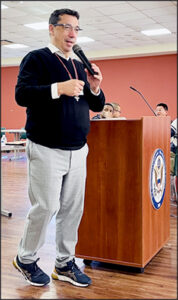 Editor’s Note: The following account of the development of the Aggregation of the Blessed Sacrament is adapted from a presentation by its author, Father Francisco Junior de Oliveira Marques SSS, General Consultor, Province of Our Lady of Guadalupe, Argentina-Brazil-Chile, made to participants in the August 4, 2026, Aggregation Day hosted at the Highland Heights, Ohio (USA), headquarters of the Province of Saint Ann. Father’s citation of historical documents appears within the text of his essay and conforms with conventions used within the Congregation’s own archival and formation literature. RA denotes the Règle de l’Agrégation (Rule of the Aggregation); CO the Correspondence of Peter Julian Eymard; PS and RR designate related sections of his collected writings; RoL the Congregation’s Rule of Life; and PoL the 2010 Project of Life of the Aggregation of the Blessed Sacrament. All are drawn from Eymard’s Œuvres complètes as catalogued by the Postulation General. MED
Introduction
In the General Archives of the Congregation of the Blessed Sacrament in Rome there sit ten separate drafts of Statutes, Manuals, Spiritual Rules and Directories, all in the same hand, all for the same purpose: what Peter Julian Eymard called the “Aggregation of the Blessed Sacrament.” Ten drafts from a man who was dying, who had every reason to spend his last strength on something else. That is where this history begins. Not with an idea but with an obstinacy. What follows is offered in that same spirit: not as a set of decisions to be made, but as an invitation to deepen a commitment already loved—for one cannot deepen a commitment one has not first loved nor love well what one does not know. How far this commitment is allowed to grow from here remains a decision for those who receive it
I. The Founder’s Dream, 1855–1859
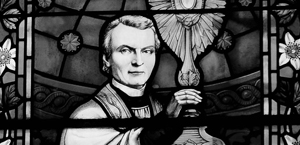
To understand the Aggregation, one must look back to a time before 1858, since Eymard himself divided his own thinking about it into two eras: before 1858, and after 1859. That hinge matters. In the beginning, he dreamed big—maybe too big. Between 1855 and 1859, he pictured one universal, independent structure, with the Aggregates as members of the Congregation itself. His draft Constitutions named three kinds of members: the religious priests, who alone could hold the Congregation’s important offices; the religious lay brothers; and, third, the “Aggregates,” defined as those “in the world: priests and laypersons who, desiring to share in the graces and merits of the [Congregation]” (RR 25). Three branches. One family. One Constitution.
Then, two things happened, back-to-back, that changed everything. On December 20, 1858, Pope Pius IX enriched this new Aggregation with several precious indulgences. Rome had noticed. And on January 5, 1859, the Congregation of the Blessed Sacrament itself received the Decretum Laudis—the Holy See’s official praise and approval. And here is the turn: the very moment his own Congregation became official, Eymard realized the Aggregates could not be members of a religious institute. Canon law would not allow it. A lesser founder might have felt that as a defeat. Eymard felt it as a summons. He sat back down and began drawing up statutes—not for members of his order, but for a diocesan union, the first legal step toward something universal. He did not wait long to see it take root. On November 17, 1859—barely barely ten months after the Decretum Laudis—Bishop Eugène Mazenod canonically erected the Aggregation in Marseille (CO 896, CO 919, PS 294,3). It did not attract members slowly. Instead, it exploded. Hundreds, then thousands of the faithful joined almost at once—in Marseille, then Paris, Angers, Brussels—everywhere Eymard’s own communities took root.
Consider how he himself defined it, in his own words, that same year: “The Aggregation of the most Blessed Sacrament . . . has as its unique goal to procure for Our Lord in the most Blessed Sacrament true adorers in spirit and in truth, who, animated by a great spirit of faith and love, adore, love, and serve him in his adorable Sacrament, and dedicate themselves to his greater glory in fraternal union with the Society of the most Blessed Sacrament” (RA 1,1). Not an auxiliary. Not a fan club for the Congregation. Eucharistic apostles, in fraternal union with the Congregation. That sentence is the whole seed of everything the Aggregation has inherited since.
II. The Fire in His Letters
Eymard did not stop at a definition. He divided the Aggregation into three classes—and it is worth naming all three, because one of them was quietly lost along the way. The first class was to be known as “the Simple Aggregates,” whom he defined as “those who fulfil their duties in isolation.” By “isolation,” Eymard simply meant someone like a layperson guided by a spiritual director who embraced a personal Eucharistic mission of their own, alone. The second class consisted of those who might come together as an associative community under the direction of a pastor or superior for the purpose of uniting their adoration “into a regular and constant Eucharistic service.” In this case, laypersons would belong to a group bound by one shared Eucharistic purpose.
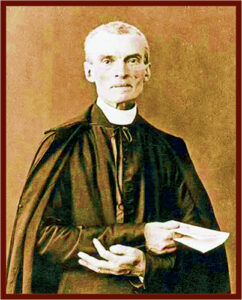 The third class of aggregates imagined by the saint were to be those who, in his words, “gather as a community of families, and form in the world something like a small religious cenacle” (RA 1,3). They can be imagined as a family living together, not merely adoring together. Three years later, on December 8, 1862, Eymard described these third-class members of the Aggregation more fully, through a note that survives unprinted in the Congregation’s archives to this day, as a fraternity of three to five members “who live in community as a family … and form in this way in the world a kind of small cenacle of the Eucharistic and religious life” (RA 11,2). It is important to note the uniqueness of Eymard’s vision here. He conceived of third-class aggregates as a small group of laypeople living almost as vowed religious but without formal vows.
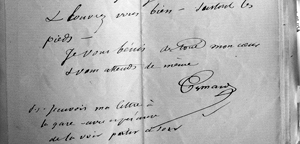
No matter which class one considers—solitary, associative or cenacle—one thing never changes. When Eymard wrote this proposal of life and mission for the laity, he did not write policy. He wrote fire. And that fire went straight into his letters, one person at a time: To Madame Clotilde Tholin-Bost of Paris, one of his earliest collaborators, for example, he wrote, “So now you belong in the Cenacle with us. . . . “[And] I would like to see you go with torch in hand, like a lightning bolt, to set the fire of Eucharistic love everywhere!” (CO 577, 744). With similar fervor he wrote to a Madame Lepage, from the French city of Rennes, encouraging her to “[r]emain always an apostle of the God of the Eucharist; it is a mission of fire near those who are cold, of light for those who do not believe, and of holiness for the soul of the adorer. Jesus said: ‘I am the bread of life’” (CO 1344). He likewise instructed the Countess Marie-Adélaïde d’Andigné, who resided for many years in Angers, France, to “have a great love for your household of [L’Isle-sur-la-Sorgue], that Bethany of our Lord, the permanent Cenacle of his Eucharistic life!” (CO 2075) and challenged Countess Fégely de Vivy, a Swiss noblewoman from Fribourg, Switzerland, to “establish a house of women Adorers in your country,” which he characterized as “the greatest, the holiest and most apostolic thing” she could do. (CO 1333).
He writes with torch in hand, like lightning, to various 19th-century laywomen, a fact that should cause us to ask ourselves with honesty when we last encountered a pastor writing to a lay parishioner with such fire? Eymard did not manage the laity. He courted them as one courts a vocation. He believed, as his letter reveal, in the ability of ordinary, French women to carry a fire he could not personally carry to every corner of France.
III. The Narrowing and the Return
Eymard died in 1868 without ever seeing the universal structure he had envisioned set in place. Rome, moved cautiously to grant official recognition to his dream (CO 1088). Nevertheless, what he left behind kept growing, and a year after his death, on May 8, 1897, the Aggregation was formally elevated by papal brief to the status of a universal association. There was a catch, however: the elevation kept all three classes on paper, but not in the way Eymard had conceived them. In effect, the Aggregation was reduced to a group of perpetual adorers of the Blessed Sacrament in the manner of those within the Congregation attracted to the so-called “Marseille model” promoted by Rev. Raymond de Cuers (1809-71) among those living in that city. The cenacle-families of the third class, that prophetic configuration of laypeople living almost as Eucharistic apostles, quietly vanished from view. Though Eymard had always intended adoration to be one of several missions his Aggregates fulfilled, by the close of the 19th century, in the words one of the Congregation’s own researchers, it had grown into “practically the exclusive one” (Barbiero 2025).
The same could be said of the Aggregation throughout the first half of the 20th century. It could be described easily enough as a group of good, faithful people, keeping holy hours. Then, however, came the Second Vatican Council (1962-65). Vatican II did not so much hand the Aggregation a new mission so much as an existing one reclaimed. The council’s comprehensive renewal of the Church deliberately steered the Congregation away from the narrow a Marseille model of piety focused on adoration alone toward what the tradition calls the “Faubourg-Saint-Jacques model” encompassing a fuller view of Eucharistic action. The Congregation’s own Rule of Life says it plainly: “Our ideal is to live fully the mystery of the Eucharist” (RoL 1). And Rule of Life 43 reopened the very door Eymard had cracked open in 1859: “We invite all those whom the Spirit directs towards the Eucharist, priests and lay people, to join our family and share its mission” (RoL 43).
Notice that verb. The Rule speaks not of “recruiting” but of “inviting.” The Spirit does the directing; the Congregation does the inviting. That is not a technicality; it is the entire theology of partnership now being stewarded by a new generation of priests and laity together. What has followed in the decades since Vatican II has not been one, isolated decision from Rome but a whole generation of grassroots experiments springing up independently, all reaching for what Eymard had reached for: From 1980-1990, ERLES, gathering religious and laity together across Latin America. The Life in the Eucharist (LITE) retreats launched in the United States in 1988 and 1989, still bearing fruit across North America today. The Emmaus Group among the Congregation’s European young adults. Tabgha, in Italy. Different names. The same hunger.
“[The Aggregation was not intended to be] an auxiliary, not a fan club for the Congregation, but Eucharistic apostles, in fraternal union with the Congregation. That sentence is the whole seed of everything the Aggregation has inherited since.”
IV. The Common House
By 2008, the Congregation’s former Superior General, Father Fiorenzo Salvi, put into words to what everyone was feeling. In a letter to the entire Congregation dated November 30, 2008, he was honest about what was still missing. “We lack a ‘common house,’ an official point of reference for a proposal of Eucharistic life for the laity,” he wrote (Salvi 2008). A hundred and fifty years in, and there was still no single address to send people to. So, the Congregation went to work. And on March 25, 2010—the Feast of the Annunciation, fittingly, the day the Word became flesh in the house of an ordinary laywoman—the new, official Project of Life for the Aggregation was announced.
Consider how it names the Aggregation in its very first line: “Animated by the spirit of Saint Peter Julian Eymard, we form the Aggregation of the Blessed Sacrament, an Association of the faithful proper to the Congregation of the Blessed Sacrament and the Servants of the Blessed Sacrament and recognized by the Church” (PoL 1). Recognized by the Church. One hundred fifty-one years after Bishop Mazenod’s decree in Marseille, the “common house” Father Salvi asked for finally had four walls and a roof. And it’s ideal, in PoL 2, could have been lifted straight from Eymard’s own pen: “Our ideal is to live the mystery of the Eucharist to the full, and to reveal its meaning, so that the reign of Christ may come, and the glory of God may be revealed to the world” (PoL 2). Full. Not adoration alone. The whole Eucharistic thought Eymard begged for when he wrote: “We have but one thought, one goal, one center: the Eucharist” (CO 609).
It is worth pausing here, because PoL 4 asks something of every aggregate that should give any reader pause, in the best way: “we are animated by the Spirit of love that led Christ to die so that we might live, and live abundantly … realizing the Apostle’s words: It is no longer I who live, but Christ who lives in me” (PoL 4). This is not merely a devotional flourish. It is the same total, self-emptying love professed by priests at their own ordination—now asked of a mother of three in a parish in Ohio, or a retired schoolteacher in one of the Congregation’s own provinces, who has never worn a collar in her life. And PoL 5 tells us how that love actually gets lived—not privately but together: “The Eucharistic form of Christian living is ecclesial and communitarian” (PoL 5). Which brings the argument to the one thing this whole spirituality cannot survive without: humility. The honest admission that none of us—priests or laypersons—can carry this love alone. Each needs the other simply to see it clearly.
V. Today and Tomorrow
So where does that leave the Aggregation, right now, in this moment of its history? The truth is that the dream Eymard could not finish in the 1860s is only now, in this generation, taking its first real breath internationally. For the first time, in June 2025, provincial and regional directors of the Aggregation around the world appointed lay representatives to sit at an international table. The first virtual meeting happened that July, the second in August. And since then, those meetings have kept coming, one after another, steadily building toward a future international council of the Aggregation. That is genuinely where matters stand: not a legacy inherited fully built but the first stones being laid, together with the laity who share the charism.
This growing reality carries, in PoL 26, the same diversity Eymard built into his three classes—the same richness, the same range of possibility. Three things, from this history, deserve particular attention. First, partnership of a corporate, not merely personal, character. When the Aggregation is tied to one beloved religious instead of to the community itself, it dies the day he is transferred, or the day he dies. It must be protected structurally, the way Eymard tried to protect it before he even had the legal language for it. Second, initial formation and the celebration of promises—still wildly inconsistent from province to province, in length and in content, with no shared rite. Third, ongoing formation—because the Spirit that “directs” people toward the Eucharist, in the language of Rule of Life 43, does not stop directing them the day they sign the register.
Conclusion— “Help Us Look”
This account of the history of the Aggregation closes with one more story, not the author’s own, not Eymard’s, but one that seems to hold everything examined here. There is a Brazilian tale about a boy named Diego, who had never seen the sea. His father, Santiago, took him south to find it. They walked a long way, until they climbed the last high dune, and there the ocean lay before them, immense and so luminous that the boy was struck speechless by its beauty. And when he finally found his voice, trembling, he did not say “thank you.” He did not say “it’s beautiful.” He turned to his father and said: “Help me look.”
That, in a sense, is the plea of the Aggregation. That is what a woman in Rennes needed from Eymard and what Eymard, in his own way, needed from her. That is what every layperson entering a parish needs from its priests and, no less plainly, what those priests need from the laity in return. None of us can face something as immense and luminous as the Eucharist alone. We need each other simply to look at it rightly. A dying priest wrote ten drafts because he refused to let that immensity go unshared. A pope granted indulgences in 1858. A bishop signed a decree in 1859. A brief made it universal in 1897. A Council brought the Congregation back to the fullness in the 1960s. A letter named what was still missing in 2008. And on the Feast of the Annunciation, in 2010, the common house finally got its address.
It is now 2026, and a new generation of the Aggregation—priests and laity together—inherits the task of writing the next line of that story. Help each other look. That is the whole history. That is the whole future. The work continues.
Bibliography
EYMARD, Peter Julian. Œuvres complètes [Complete Works], including the Règle de l’Agrégation (RA) and Correspondance (CO). Rome: Postulation General of the Congregation of the Blessed Sacrament. Available at eymard.org.
PIUS IX. Rescript granting indulgences to the Aggregation of the Blessed Sacrament. Rome, 20 December 1858.
CONGREGATION OF THE BLESSED SACRAMENT. Decretum Laudis. Rome, 5 January 1859.
HOLY SEE. Apostolic Brief elevating the Aggregation of the Blessed Sacrament to a universal association. Rome, 8 May 1897.
SALVI, Fiorenzo, SSS. Lettre aux supérieurs provinciaux et régionaux, aux supérieurs locaux et leurs communautés, aux religieux chargés d’animer et de suivre les groupes de laïcs associés. Rome, 30 November 2008.
CONGREGATION OF THE BLESSED SACRAMENT. Rule of Life (RoL). Rome: SSS.
ASSOCIATION OF THE AGGREGATION OF THE BLESSED SACRAMENT. Project of Life (PoL). Official edition, 25 March 2010.
BARBIERO, Manuel, SSS. The Aggregation of the Blessed Sacrament. English ed., 2025.
Download a pdf version of this article here.
©2026 Emmanuel Magazine, Congregation of the Blessed Sacrament
All rights reserved.
Readers may reach editor Michael E. DeSanctis at editor@blessedsacrament.com and by mail at Emmanuel Magazine, Editorial Office, 220 Seminole Dr., Erie, PA, 16505.