




Truths As Plain as Day: Recounting My Recent Aggregation Day Experience
I was pleased to participate in the August 4, 2026, Aggregation Day hosted by the Congregation of the Blessed Sacrament representing the Province of Saint Ann at its headquarters in Highland Heights, Ohio, (USA). Liturgies for the event and the Provincial Chapter Meeting that followed a day later took place in the site’s primary settings for worship, the parish church of St. Paschal Baylon and the more modestly-scaled Saint Ann Shrine, with which many Emmanuel readers are likely familiar, if only from pictures.
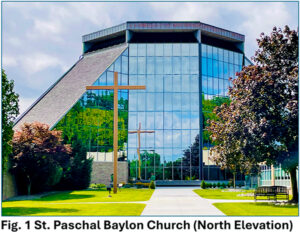
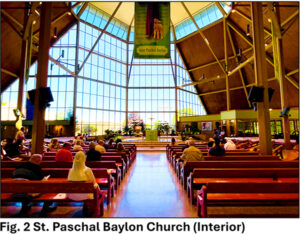
The former, a spectacular, steel-framed structure clad from top to bottom in glass, has a tent-like appearance linking it with the longstanding Judeo-Christian tradition of preserving sacred objects and actions beneath canopies made by human hands for purposes regarded as strictly divine (figs. 1 and 2). Its centralized liturgical plan offers pew seating for worshipers arranged in semicircular fashion around the altar, ambo and presider’s chair of a raised sanctuary platform (bema). The church’s transparent walls permit an abundance of natural light to fill its interior while granting users unrestricted views of its landscaped surroundings. The sheerness of their surfaces likewise contributes to an acoustical environment that directs sound upward, like ritual incense, toward the large, octagonal lantern hovering some seven stories above the heads of worshipers.
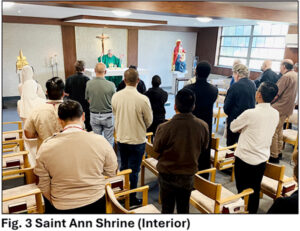
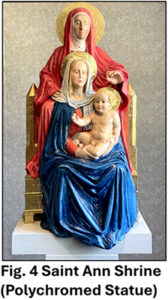
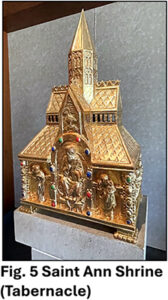
Much different in character is the Saint Ann Shrine, whose compact volume is laid out in the manner of a monastic choir (fig. 3). Here, worshipers address each other across a narrow processional aisle from rows of moveable chairs only steps removed from the major liturgical appointments. Close by, as focuses of devotional prayer, stand a polychromed figure grouping in wood of the enthroned Saint Ann, Blessed Mother and Christ Child and a Gothic-styled tabernacle, whose gabled roof and spire lend it the appearance of a miniature church (figs. 4 and 5). The setting’s low ceiling, carpeted floor and dark-stained perimeter paneling lend it an insular quality. They also do much to sustain the quiet that prevails within it.
Though this was my first time worshiping in either setting since becoming editor a year ago of Emmanuel Magazine, I assumed beforehand that any liturgical action I’d witness there at the invitation of a religious community explicitly devoted to the cause of Eucharistic prayer would have to be special. My hunch proved right—and not only for reasons having to do with architecture.
A stickler for detail myself, who’s spent a career helping Catholic parishes across the country build or renovate places of worship in keeping with the instructions of Vatican II, I was struck from the start by the care with which each of the worship services scheduled for the occasion had been planned. Not very often, frankly, have I witnessed the rites of the Church conducted with such forethought—an indication to me the day’s planners understood that good liturgy doesn’t simply “happen” on its own but takes the involvement of persons deeply committed to lifting their hearts to God together as one body.
“There’s nothing arbitrary to be found in great works of art, music, drama or literature,” I used to tell the budding theologians and art historians at the Catholic, diocesan university in Erie, Pennsylvania, where I taught classrooms full of both for decades. The same can be said of the Church’s sacramental prayer, of course, which, by its nature, must enthrall the senses of its participants as much it does their minds and souls. I was reminded of this truth even before each of the Aggregation Day liturgies in which I participated had begun as I examined the handsome Order of Mass programs prepared for each. Substantial in the hand at thirty or forty pages, I can only guess at how much time went into assembling their contents. The same could be said of the Mass celebrations themselves, presented as they were in a deliberate and unrushed manner one rarely experiences in Catholic parish settings nowadays.
This is not to say that our parishes are incapable of worship that has the ring of excellence to it, only that it remains the exception. The bishops of the Second Vatican Council suggested that a combination of “zeal and patience” (Sacrosanctum Concilium, 19) on the part of pastors and other overseers of liturgy in their local communities might do the trick. “Zeal,” which might be taken to mean genuine enthusiasm for Catholic ceremonial life, comes easily to those who treat it as a proper outlet for their own creative talents. It’s a characteristic of the church musician or parish liturgist who thrills, say, over some part of the annual Triduum or Easter Vigil rites in which they’ve played a hand coming off particularly well, or when a musical setting of the Ordinary literally strikes a chord with the people in the pews expected to sing it.
Equally important, however, as the bishops of Vatican II noted, is the kind of day-to-day concern for the requirements of corporate worship that preserves it from becoming just another ministerial chore among many to which attention must be paid. This sort of “patience”—to use the council’s term—comes hard today for those who, despite their love for worship, find themselves strapped for time and resources and immersed in a larger, national culture given more to pragmatism than to the lofty requirements of Catholic liturgical theology or aesthetics.
Here’s where I think the Congregation and its mission prove so important.
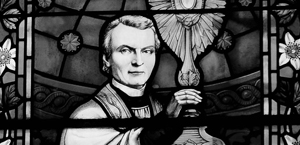
As a circle of Catholic faithful for whom the Eucharist represents not only a form of prayer but a way of life, we remain models of service to the Church and promoters of its noblest sacrament. In the mind of founder Saint Peter Julian Eymard (1811–1868), such servanthood was to mimic Jesus’ own regard for his followers expressed through his willingness to render himself uniquely present to them at very altar or sacrifice or adoration (Notes on Meekness, The Eucharist and Christian Perfection—I).
It’s precisely this attitude of service to others that I encountered repeatedly throughout my Aggregation Day experience—not simply the sort of politeness one anticipates nowadays at the typical, corporate retreat or workshop but something quite deeper. You could call it “reciprocal ministry” or just plain, old “Christian fellowship” embodied in everything from the eagerness with which participants volunteered to assume roles in any of the liturgies scheduled for the occasion to the way they pitched in to rearrange furniture when needed in the lunchroom we shared for meals.
Indeed, at every turn I seemed to catch someone doing something kind for someone else. Often, it was Provincial Superior Father John Thomas Lane SSS, just elected to a second term in that position, whom I’d spy addressing from behind the scenes some seemingly minor matter that turned out to carry considerable significance for those in attendance. The same could be said of Brother Gary LaVerdière SSS, who was kind enough to introduce me at length to the contents of Emmanuel Magazine’s extensive archive collection. So, too, of the anonymous person on-site who not only saw to making my overnight accommodations clean and comfortable but who affixed to their entrance door a sign bearing my name so beautifully lettered as to hardly seem temporary.
In short, what I beheld were repeated gestures of Eymardian “care and charism,” the former related to a human virtue thought to be universal, the latter to something rarer that we look to heaven to instill in us. Rev. Roger C. Bourgeois SSS (1930-2026), who, sadly, has died even as I complete these remarks, may have encapsulated this best in the homily he offered at early-morning Mass in the Saint Ann Shrine on Wednesday of the 18th Week in Ordinary Time. (Please see the complete text of Fr. Roger’s homily reproduced in the September installment of Emmanuel.) In it, Father compared God’s fidelity to ancient Israel as described by the Prophet Jeremiah (31:1-7) with the kindness Jesus shows the Canaanite woman recorded in the Gospel of Matthew (15:21-28). Both reveal the nature of divine love, Father Roger explained, which, by never diminishing, inspires us time and again to draw close to our Heavenly Creator without fear. This is not an exchange that plays out according to any of our predetermined timetables, Father insisted. It can’t be engineered into being for quickest results but unfolds slowly, organically—as all love relationships do—according to the timeless Mystery that is God.
Clock-driven as we’re inclined to be today, we rehearse our comfort with timelessness through each celebration of the Mass, of course, each moment spent in Eucahristic Adoration. So, too, through Christ-like acts of hospitality toward others of the kind I observed during the recent Aggregation Day event, sacramental acts in themselves and ways of extending God’s goodness beyond the boundaries of our altars.
Download a pdf version of this article here.
©2026 Emmanuel Magazine, Congregation of the Blessed Sacrament
All rights reserved.
Readers may reach editor Michael E. DeSanctis at editor@blessedsacrament.com and by mail at Emmanuel Magazine, Editorial Office, 220 Seminole Dr., Erie, PA, 16505.