



Places for Performing the “Work of Angels”
Some Recent Examples of Catholic Adoration Chapels
Gianfranco Tassara
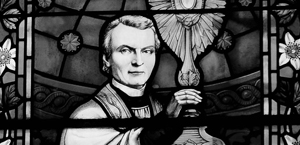
Editor’s Note: Saint Peter Julian Eymard (1811-68) once stated that “to adore [Christ in the Eucharist] is to perform the work of angels.” If this be true, then the corners of Catholic places of worship set aside for acts of Eucharistic adoration by the faithful must be so designed as to impress upon them the uniqueness of their actions. Built of Living Stones, the set of guidelines on art and architecture for worship promulgated in 2000 by the United States Conference of Catholic Bishops, encourages parish communities to establish places for reservation and adoration of the Blessed Sacrament that are “worthy and distinguished” (Art. 249). The document goes on to say that in no way should they appear to be “temporary, makeshift or difficult to find” (Art. 249).
The particular appearance of such places, of course, which may take the form of full-blown “chapels of adoration,” is left to the architects and related design professionals parishes retain for their knowledge of both the aesthetic and theological aspirations of the Church. In the following essay, Gianfranco Tassara, owner of Inspired Artisans (www.inspiredart.com), a family-run sacred art studio located in Milwaukee, Wisconsin, shares with our readers details of some of the projects for adoration chapels in which his own firm has played a hand. MED
 The world can be an overwhelming place and one that can can often distract us from prayer. While God hears us wherever we are, sometimes we need respite and quiet to feel our deepest connection with him. For Catholics, both can be found in the so-called “adoration chapels” that, since Vatican II, have come to be incorporated into many of our places of worship. It is there, in surroundings specifically dedicated to this purpose, that we encounter the Eucharistic Christ outside the context of the Mass.
At Inspired Artisans, the Milwaukee-based sacred art studio I founded in 1997, we have had the pleasure in recent years of designing and fabricating major elements for three adoration chapels. In each case, our work has been guided by close attention to the needs of our parish-clients, by the architectural character of their existing places of worship, and by the Church’s universal norms for reservation and adoration of the Blessed Sacrament. Among these projects are the following:
St. Michael Catholic Church, Wheaton, Illinois
Rebuilt in 2006 after a fire, St. Michael Catholic Church has a bright, contemporary interior grounded in traditional Catholic imagery. Warm wood, pale stone and soft gray-green walls frame the sanctuary, while stained glass and a soaring ribbed ceiling draw the eye toward the altar and crucifix. The serene, open setting is well-suited to prayer and quiet contemplation, but an adoration chapel was missing.
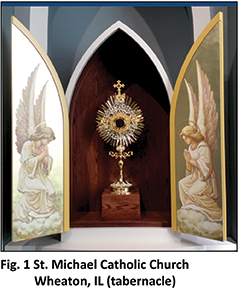
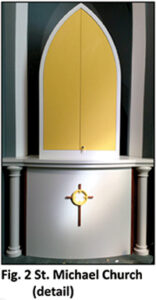
St. Michael Catholic Church commissioned our firm to produce a vessel and a new pedestal for their existing monstrance (fig 1). The vessel is framed by warm yellow doors that create an inviting first impression before opening to reveal two kneeling angels resting on clouds in adoration of the Eucharist. Both angels are surrounded by the luminous richness of gold leaf. The pedestal is intentionally understated to let the vessel’s color and imagery shine. A clean white finish is complemented by the dark-stained wood mirrored inside the vessel’s interior, as well. The restrained palette of gold, dark wood and white is repeated throughout the piece, which allows is to stand out from the the soft grey of the wall behind it.
St. Margaret Mary Church, Naperville, Illinois
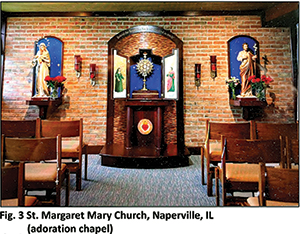
St. Margaret Mary Church in Naperville, Illinois, completed in 1983, has a warm and contemporary interior centered on a broad, fan-shaped nave. Honey-colored pews face a sanctuary of dark brick and exposed timber illuminated by a central skylight. Stained glass, green plants, and simple devotional elements soften the architecture and create an intimate, welcoming atmosphere for worship. For the church’s place of adoration (fig. 3), Inspired Artisans designed and fabricated a housing for the monstrance that incorporates a number of art forms. Together these contribute to a setting that fosters contemplation and worship.
The monstrance is housed in a wooden vessel whose arched outer frame is inscribed in gold with one of the revelations of the Sacred Heart attributed to the parish’s namesake, St. Margaret Mary Alacoque (1647-90): “Behold the Heart that has loved mankind so much!” (fig. 4). Between the pillars of the pedestal supporting this vessel is affixed the familiar emblem of the Sacred Heart handed down by Catholic devotional tradition. Icons of St. Margaret Mary and St. John Eudes (1601-80), early promoters of devotion to the Sacred Heart, appear on the inner sides of the vessel’s doors. The saints are depicted as standing on clouds amid gold leaf, as if beckoning parishioners to join them in adoring the Sacrament in its monstrance. The latter are backed by a painted representation of a star-filled sky in Prussian blue.
Flanking these Eucharist-centered features of the chapel are statues of the Madonna and Child and St. Joseph, both carried on brackets attached a brick wall and offset by smaller versions of the arched framing device that surrounds the housing for the Blessed Sacrament. These large-scale figures of Mary and Joseph are similarly backed by their own, painted sections of the night sky that connect them with the treatment of chapel’s central appointments.
Saints Peter and Paul Catholic Church, New Braunfels, Texas
The current home of Saints Peter and Paul Catholic Church was constructed between 1922 and 1925, after a fire. It is a charming example of the Gothic Revival architecture. A central aisle leads toward a sanctuary framed by a pointed arch and a deep blue, star-filled apse. Stained glass, red-and-gold ornamentation, Italian marble, and dark wood give the space its rich character and create a dignified, deeply prayerful atmosphere. Inspired Artisans participated in the redesign of the church’s adoration chapel and sanctuary. Our biggest contribution was a housing for the monstrance in the form of a gabled structure of dark-stained lindenwood embellished with 23-karat gold leaf (fig. 5).
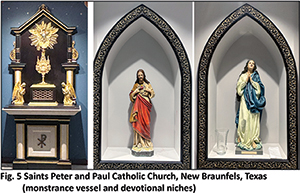
The design of the monstrance housing draws from elements found throughout the interior of the church. At its center is a three-dimensional rendering of the Holy Spirit in the form of a dove superimposed on a sunburst. Beneath this, flanking the monstrance, kneel a pair of attendant cherubim. All three figurative details were carved and gilded by hand. The pedestal for the monstrance is made of Botticino marble and features a central panel emblazoned with the Chi Rho. Its form combines both traditional and contemporary design elements meant inspire reverence in its beholders. The whole is backed by a mural depicting a star-filled sky that invites worshipers to contemplate the celestial dimension of the Eucharist.
Inspired Artisans is pleased to have been involved in the development of the chapels presented in this short essay and is poised to help other Catholic parishes throughout the country devise facilities of their own reserved for the sole purpose of Eucharistic adoration.
Download a pdf version of this article here.
©2026 Emmanuel Magazine, Congregation of the Blessed Sacrament
All rights reserved.
Readers may reach editor Michael E. DeSanctis at editor@blessedsacrament.com and by mail at Emmanuel Magazine, Editorial Office, 220 Seminole Dr., Erie, PA, 16505.